


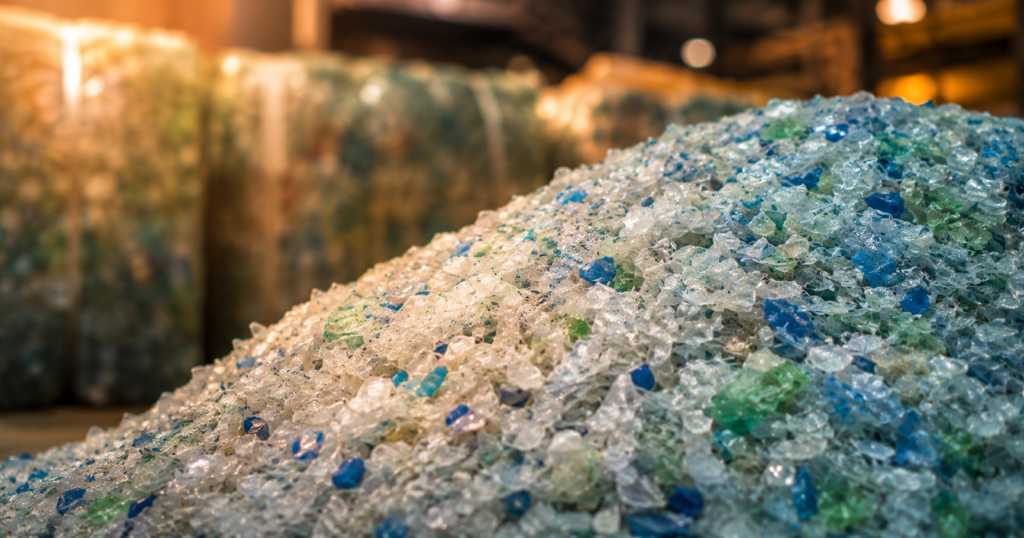
PET Recycling Filtration: The Complete Guide to rPET Melt Filtration
Recycled PET (rPET) is the most demanding polymer melt filtration challenge in thermoplastics processing. Contamination is heterogeneous, particle hardness is extreme, and the quality thresholds for food-contact applications leave no margin for filtration failure. Getting the filtration specification wrong means either quality failures at the die or unmanageable downtime from screen saturation.
According to the European PET Bottle Platform (EPBP), demand for food-grade rPET resin in Europe reached 1.2 million tonnes in 2024 — and the EU Packaging and Packaging Waste Regulation (PPWR) mandates 30% recycled content in PET beverage bottles by 2030. The filtration technology that makes food-grade rPET possible is not optional — it is the rate-limiting step.
Why PET Recycling Filtration Is Different from Other Polymers
PET (polyethylene terephthalate) presents a specific set of filtration challenges that distinguish it from polyolefin recycling. Three properties make rPET filtration technically demanding in ways that standard LDPE or PP recycling equipment is not designed to handle.
First, thermal sensitivity. PET degrades rapidly above its processing temperature window — typically 270–290°C for bottle-grade resin. Degradation produces acetaldehyde (AA), which is a taste and odour contaminant in food-contact applications with a detection threshold of approximately 10 ppb. Any filtration system that creates dead zones or residence time irregularities — including screen changers that generate melt stagnation during the change cycle — introduces thermal degradation risk that manual systems cannot avoid.
Second, contamination hardness. Post-consumer PET bottles carry glass fragments, metal closures, aluminium labels, silicone gaskets, and ceramic particles — all significantly harder than the polymer melt they travel in. These abrasive particles damage screen pack wire mesh faster than soft contaminants and accelerate breaker plate wear. The Plastics Recyclers Europe (PRE) contamination analysis of bottle-grade PET streams documents metal and glass particle contamination at 0.1–0.5% by weight — low by total weight, but catastrophically abrasive to fine filtration elements.
Third, intrinsic viscosity (IV) sensitivity. Recycled PET undergoes IV degradation during reprocessing — each thermal cycle reduces molecular chain length and reduces IV from the typical bottle-grade specification of 0.72–0.78 dl/g. Pressure events during screen changes cause local overheating and accelerated IV degradation at the filter zone. Continuous filtration eliminates these pressure events, preserving IV closer to input specification throughout the extrusion run.
rPET Contamination Profile: What the Filter Actually Sees
The contamination profile of post-consumer PET bottle flake — the primary feedstock for rPET extrusion — differs significantly from post-consumer polyolefin film. According to EPBP quality standards for food-grade rPET, acceptable feedstock contains less than 50 ppm metals, less than 200 ppm PVC, and less than 500 ppm total non-PET polymer content by weight. In practice, real-world flake streams from collection and sorting systems routinely exceed these targets before washing.
The particles that reach the melt filtration stage after washing, drying, and solid-state processing include: residual PVC cap liner fragments (which degrade at PET processing temperatures and release HCl), polyolefin caps incompletely separated in NIR sorting, adhesive residues from labels, fine glass fragments from broken bottles in the collection stream, and metal shards from aluminium closures. Filtration fineness in rPET food-contact applications must capture particles above 60–80 μm — finer than standard blown film filtration — to protect the final product from both contamination defects and analytical failure in migration testing.
Source: EPBP
Screen Pack Specification for rPET Extrusion
Screen pack selection for rPET extrusion depends on the end application, the IV target, and the contamination level of the input flake. The table below maps the principal rPET applications to their filtration requirements. For mesh-to-micron conversions of any specification listed, use the Mesh-to-Micron Converter.
| Application | Mesh range | Aperture (μm) | IV target (dl/g) | Key requirement | System |
|---|---|---|---|---|---|
| Food-contact sheet (thermoforming) | 200–325 mesh | 44–74 μm | ≥0.70 | Migration compliance, no black specks | AP Series |
| Bottle-grade rPET (B2B) | 200–250 mesh | 53–74 μm | ≥0.72 | Low AA, colour (b*), no PVC | AP Series |
| rPET fiber / staple / filament | 250–400 mesh | 37–53 μm | ≥0.62 | Spinneret protection, filament continuity | AP Series |
| Strapping tape / strap | 150–200 mesh | 74–105 μm | ≥0.80 | Tensile strength — no voids or inclusions | AP Series |
| Non-food rPET sheet / technical | 100–150 mesh | 105–149 μm | ≥0.60 | Surface quality, dimensional consistency | AP Series or hydraulic |
| Heavily contaminated flake (pre-wash) | 40–80 mesh primary | 177–420 μm | N/A (pre-stage) | Gross contaminant removal before fine stage | Gorillabelt |
Aperture values based on ASTM E11 plain weave nominal specification.
For fiber spinning filtration in depth, see the wire, cable & fiber extrusion filtration guide →
Two-Stage Filtration for Food-Grade rPET
Food-grade rPET extrusion lines routinely use two-stage filtration: a coarse primary stage to remove gross contaminants (metal, glass, hard particles above 150–200 μm) followed by a fine secondary stage at 200–325 mesh for final quality filtration. The two stages may be combined in a single screen changer housing with a multilayer screen pack, or installed as two separate units in series.
The advantage of separate stages is that the primary stage can be a belt-type continuous system capable of handling abrasive hard particles without risk to the fine filtration elements — which are reserved for the secondary stage where contamination load is already reduced. This two-stage architecture allows finer secondary filtration at lower ΔP and longer element life than a single-stage approach attempting to capture the full contamination spectrum.
Thermal Degradation and Screen Changes: The Hidden Quality Risk in rPET
Every screen change on a discontinuous system is a thermal degradation event in rPET processing. When melt flow is interrupted or reduced during a screen change — whether for 30 seconds on a hydraulic system or 30 minutes on a manual one — the polymer in the dead zones of the filter housing continues to experience thermal exposure without the cooling effect of melt flow. At PET processing temperatures of 270–290°C, residence time above 5–8 minutes without flow initiates measurable IV degradation and acetaldehyde formation.
The practical consequence is that manual and hydraulic screen changers introduce a recurring quality risk that is invisible in standard process monitoring but detectable in downstream product testing. A food-contact rPET thermoforming sheet manufacturer running manual screen changers with two changes per 8-hour shift generates 16 thermal degradation events per day — each one a potential source of elevated AA or colour deviation in a batch that may not be identifiable until it has already been converted and tested.
“In PET, the screen change is not just a maintenance event — it is a quality event,” notes a process engineer specialising in food-contact rPET extrusion. “Every pressure drop and flow interruption leaves a thermal fingerprint in the melt. With food-contact migration limits as tight as they are, we cannot afford to accumulate that fingerprint twice per shift.”
How Continuous Filtration Protects rPET Quality
A continuous self-cleaning screen changer eliminates the flow interruption that drives thermal degradation. The AP Series cleans the screen in place while melt flows continuously — there is no dead zone, no pressure drop event, and no stagnant melt zone. Melt pressure remains within ±2% throughout the cleaning cycle, eliminating the pressure-induced temperature spikes that accelerate IV degradation.
The measurable effect is preservation of IV closer to input specification. According to process data from rPET extrusion operations that have upgraded from discontinuous to continuous filtration, IV loss across the extruder and filter zone decreases by 0.02–0.04 dl/g — a difference that directly affects downstream processability in bottle preform injection and fiber spinning. For bottle-grade applications where the IV floor is 0.72 dl/g, a 0.03 dl/g preservation improvement can be the difference between on-spec and off-spec output at the end of a long production run.
What Is Your rPET Screen Change Frequency Costing You?
Enter your rPET line throughput, screen change frequency, and shift schedule. The Cofit Productivity Savings Calculator shows your monthly output loss and annual revenue impact in under two minutes.
Selecting the Right Filtration Technology for rPET
The correct screen changer technology for rPET extrusion depends on three variables: the contamination level of the incoming flake, the end application quality requirements, and whether the line processes bottle-grade or lower-grade rPET streams. The selection logic is straightforward once these three variables are known.
- Processing food-grade or bottle-grade rPET with total contamination below 3% by weight
- Application requires fine filtration (200 mesh and above) with stable melt pressure
- IV preservation is a quality KPI — thermal degradation from screen changes is not acceptable
- Line runs 2+ shifts per day with screen life below 8 hours
- Product is food-contact: thermoforming sheet, preform extrusion, fiber for food packaging
For the full decision framework, see the guide to continuous vs discontinuous screen changers →
- Processing heavily contaminated post-consumer flake above 3–5% contamination by weight
- Hard particle contamination (metal, glass, ceramic) exceeds safe operating range for self-cleaning elements
- Operating a pre-filtration primary stage ahead of a fine self-cleaning secondary stage
- Line processes mixed PET/polyolefin contaminated streams — non-food or industrial recycling grades
- Belt replacement economics are preferable to high cleaning cycle frequency at very high contamination rates
The PPWR Compliance Dimension
The EU Packaging and Packaging Waste Regulation imposes mandatory minimum recycled content requirements that are rewriting the economics of rPET processing. The 30% recycled content mandate for PET beverage bottles by 2030 — rising to 65% by 2040 — means that converters must process significantly more post-consumer rPET per tonne of output than today. As AMI Consulting’s European PET market analysis documents, this volume increase will require proportional increases in rPET processing capacity, with filtration technology being the principal technical bottleneck.
Lines that currently run 20–30% rPET content with acceptable screen change frequency will face unsustainable filtration loads at 50–65% rPET content using the same equipment. The correct preparation is not to upgrade screen changers reactively when downtime becomes unmanageable — it is to specify continuous filtration technology for any rPET line today that will need to reach 40%+ rPET content by 2028–2030.
Abrasion, Screen Life, and Maintenance in rPET Filtration
The abrasive contamination profile of post-consumer PET flake — glass fragments, metal shards, ceramic particles — reduces screen pack life significantly compared to polyolefin recycling applications at equivalent filtration fineness. At 200-mesh filtration on an rPET line processing bottle flake with 0.3% by weight hard particle contamination, screen life is typically 4–8 hours at 200–300 kg/h — compared to 12–24 hours for equivalent fineness on virgin LDPE.
The correct response to abrasive contamination is not to use coarser filtration — that compromises product quality — but to use screen materials rated for abrasive service and to deploy continuous filtration that manages screen saturation without line stops. For the highest abrasion resistance, sintered or woven metal fibre filter elements can replace standard wire mesh in the fine filtration stage, offering equivalent filtration fineness with significantly longer element life under abrasive particle loads.
Breaker plate wear is a secondary maintenance issue specific to rPET processing. Hard particles that pass through the coarse pre-filtration stage — particularly glass fragments above the primary stage mesh aperture — impact the breaker plate perforations at high velocity under melt pressure. Over time, this erodes the perforation edges and eventually deforms the plate geometry. On high-contamination lines, breaker plate inspection every 2,000–3,000 operating hours is standard maintenance practice, as documented in equipment maintenance guidelines published by the Association of Plastics Recyclers (APR).
The Economics of rPET Filtration: Downtime, Scrap, and IV Loss
The economic case for continuous filtration in rPET processing has three components that are absent or minor in virgin polymer processing: direct downtime cost, quality scrap from thermal degradation events, and IV loss-related yield reduction.
Direct downtime follows the same arithmetic as other extrusion applications. According to Plastics Technology, extrusion downtime costs $200–$500 per line-hour. An rPET thermoforming sheet line running 300 kg/h, two shifts per day, with three manual screen changes per shift at 25 minutes each loses 250 hours of production per year. At a conservative output value of €2.50/kg, the annual direct downtime cost reaches €187,500.
Quality scrap from thermal degradation is harder to quantify but real. Each screen change event generates a batch of material with elevated acetaldehyde or colour deviation that must either be downgraded (non-food-contact use) or scrapped entirely. On a food-contact production line where the entire batch between screen changes must meet migration testing specifications, a single degradation event can condemn hours of output. Industry operating data from rPET converters suggests that degradation-related quality losses add 1–3% to effective annual scrap rate on lines using discontinuous screen changers.
Three cost components unique to rPET vs virgin PET filtration:
1. Direct downtime — same as any extrusion line, but screen life is shorter at equivalent fineness due to abrasive contamination
2. Quality scrap from AA/colour events — each screen change in a food-contact line is a degradation risk
3. IV loss yield reduction — 0.02–0.04 dl/g IV loss preserved per run by eliminating pressure events; at bottle-grade IV floors, this is product vs. off-spec material
For a complete calculation of the direct downtime component on your rPET line, use the Cofit Productivity Savings Calculator — it takes under two minutes with four input values.
Cofit Filtration Solutions for rPET Extrusion
Two product families cover the rPET filtration spectrum — fine continuous filtration for food-grade and bottle-grade applications, and continuous belt filtration for heavily contaminated pre-washing streams.
Continuous self-cleaning filtration for food-contact rPET thermoforming sheet, bottle-grade resin, fiber, and strapping. Screen cleaned in place — no flow interruption, no thermal degradation event, melt pressure stable within ±2%. Preserves IV closer to input specification by eliminating pressure events across the filter zone.
- No flow interruption — no AA spike, no colour event
- Filtration fineness: to 44 μm (325 mesh) for fiber applications
- Suitable for: food-contact sheet, B2B bottle resin, fiber, strap
- IV preservation: eliminates pressure-event degradation
Continuous belt filtration for heavily contaminated rPET streams — pre-wash flake, mixed-colour streams, or high hard-particle loads. Belt advances continuously; no cleaning cycle; abrasive particles exit with the belt rather than accumulating against the filter element. Ideal as primary stage ahead of AP Series fine filtration.
- Contamination tolerance: up to 10% by weight
- Abrasive particle handling: metal, glass, ceramic
- Suitable for: pre-wash flake, industrial grade rPET, primary stage
- Belt advance: continuous, no saturation limit
Frequently Asked Questions
Food-contact rPET applications — thermoforming sheet for trays and cups, preform extrusion for bottle-to-bottle recycling — require filtration fineness of 200–325 mesh (44–74 μm aperture, ASTM E11). This fineness is specified to capture residual PVC fragments (which degrade and release HCl at PET processing temperatures), fine glass particles from bottle streams, and carbonised polymer specks that would appear as black or brown inclusions in transparent sheet. For rPET fiber applications used in food packaging (e.g. nonwoven produce bags), 250–400 mesh (37–53 μm) is standard to protect the spinneret from micro-inclusions that cause filament breaks. These specifications are stricter than standard blown film filtration because food-contact migration limits leave no tolerance for contamination reaching the product surface.
PET recycling requires continuous filtration for two reasons that are absent or less critical in polyolefin recycling. First, PET’s thermal sensitivity at 270–290°C means that every melt flow interruption during a screen change creates a dead zone of stagnant melt that undergoes accelerated degradation, generating acetaldehyde (AA) and IV reduction. In food-contact applications where AA migration limits are measured in parts per billion, this recurring degradation event is a quality risk on every screen change. Second, post-consumer PET flake carries harder contaminants — glass, metal, ceramic — than polyolefin film, reducing screen life and increasing change frequency, which amplifies the degradation exposure. Continuous self-cleaning filtration eliminates both the flow interruption and the associated thermal degradation event.
Intrinsic viscosity (IV) is a measure of PET molecular chain length — higher IV indicates longer chains and higher melt strength. Bottle-grade PET is specified at 0.72–0.78 dl/g IV; fiber-grade at 0.62–0.68 dl/g. During reprocessing, each thermal cycle degrades IV by breaking chain bonds — a process accelerated by elevated temperatures, oxygen exposure, and moisture. Pressure events during screen changes cause local melt overheating at the filter zone, contributing to IV reduction above the baseline thermal degradation of the extrusion process. Process data from rPET lines upgrading from discontinuous to continuous filtration shows IV preservation of 0.02–0.04 dl/g across the filter zone — the difference between consistent on-spec output and periodic IV floor exceedances in bottle-grade production.
The EU Packaging and Packaging Waste Regulation mandates 30% recycled content in PET beverage bottles by 2030 and 65% by 2040. This directly increases the volume of post-consumer rPET that must be processed per tonne of finished packaging — and therefore increases the contamination load handled by filtration systems per unit time. A line currently running 20% rPET content at manageable screen change frequency will face 2–3 times the filtration load at 40–60% rPET content, using the same throughput and filtration fineness. Lines that are not already equipped with continuous filtration technology will need to upgrade before PPWR targets become binding, or face the choice between reducing rPET content below the regulatory floor or accepting unsustainable downtime from screen saturation.
Black specks in rPET extrusion are caused by carbonised polymer — degraded PET or contaminating polymers (particularly polyolefin caps and labels) that have undergone severe thermal degradation. They form in dead zones of the extruder, filter housing, or die; in residual material from previous runs that has not been purged; and from degraded contamination in the feedstock itself. Fine melt filtration at 200–325 mesh physically removes carbonised particles above 44–74 μm before they reach the die. However, filtration captures existing particles — it does not prevent new ones forming in hot spots or dead zones. The combination of continuous filtration (eliminating dead zones in the screen changer) and correct extruder design minimises both the formation and the passage of black specks to the finished product.
Find Out What Your rPET Screen Changes Are Costing You
Enter your rPET line throughput, screen change frequency, and shift schedule. The Cofit Productivity Savings Calculator shows your monthly output loss and the annual revenue you are leaving on the table — in under two minutes.
Cofit deals with research, engineering, manufacture and distribution of automatic and continuous screen changers for post-consumer and post-industrial recycling materials too.
Contact us to upgrade your extrusion system, ask us for more info about any product or service.