



How to Choose Melt Filtration for Mixed Post-Consumer and Post-Industrial Plastic Waste
Direct answer
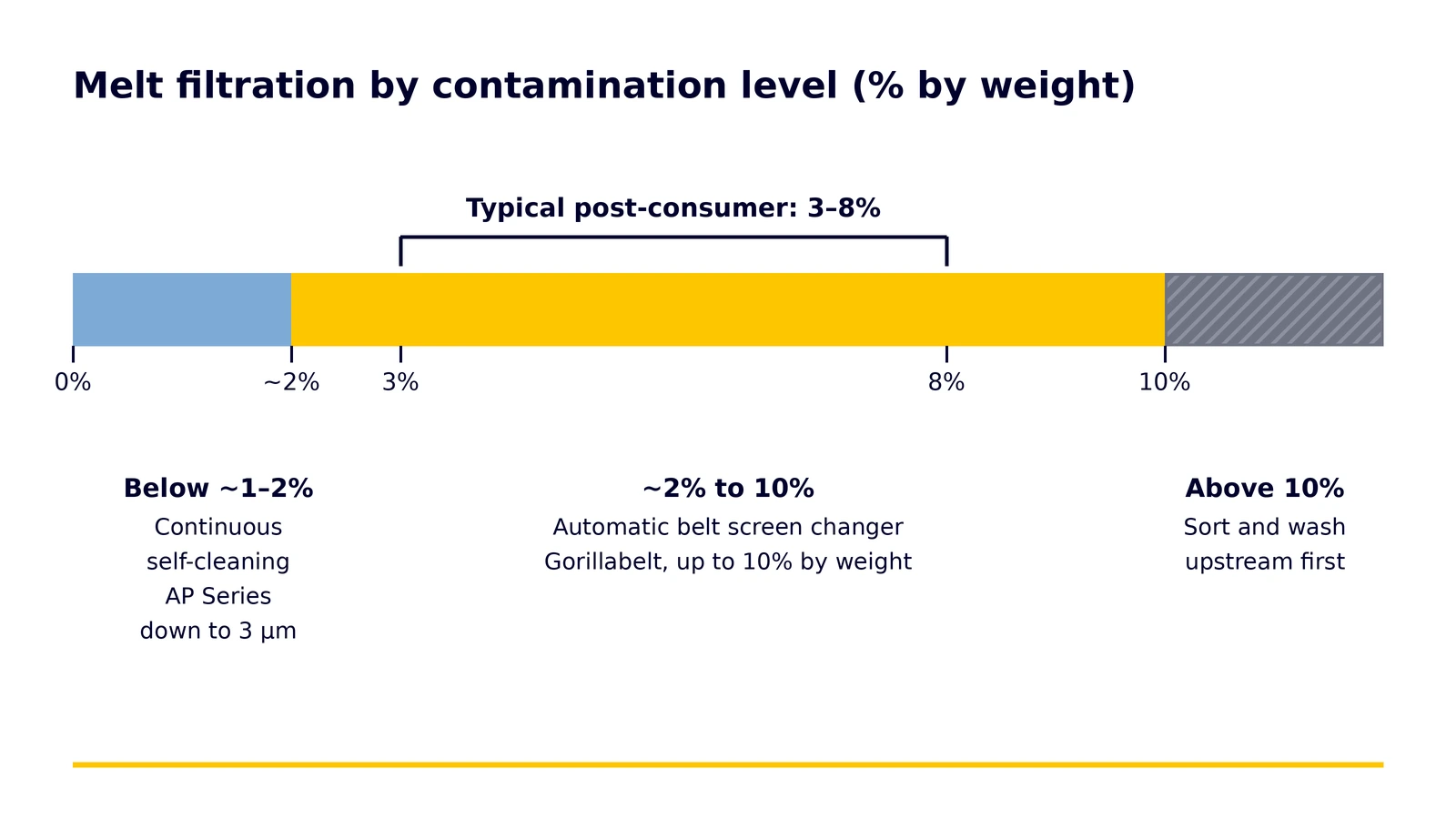
For mixed post-consumer and post-industrial recycled plastics, choose the screen changer by the contamination level and type of the dirtiest batch in the blend, not by the stream label. Below about 1–2% contamination by weight, a continuous self-cleaning screen changer such as Cofit’s AP Series filters down to 3 μm without line stops. From about 2% up to 10% by weight (typical post-consumer feedstock runs at 3–8%), or whenever hard particles such as aluminium, metal, glass or wood are present, an automatic belt screen changer such as Cofit’s Gorillabelt is the most robust choice. Above 10%, sort and wash upstream first. For high-quality pellets, combine the two in a two-stage line.
Why mixed post-consumer and post-industrial streams are harder to filter
Post-industrial scrap – edge trim, start-up waste, off-spec rolls and production rejects from converters – usually contains one polymer or a few known polymers, with a documented processing history and relatively low, uniform contamination. Post-consumer waste is different: packaging, film and rigid containers collected after use arrive with labels, paper, adhesives, food residues, metal, soil and other polymers, and the mix changes from bale to bale. Typical post-consumer feedstock carries 3–8% contamination by weight.
When a recycling line runs both streams together, the filtration system has to be sized for the dirtiest batch, not for the average of the blend. A filter that copes comfortably with the post-industrial share will be overwhelmed every time a heavily contaminated post-consumer bale reaches the extruder. The result is rising melt pressure, unplanned screen changes and swings in pellet quality.
Before comparing technologies, answer three questions about your feedstock:
- How much contamination by weight do your dirtiest batches carry, not your average ones?
- What type of contamination is it: hard and abrasive, soft and deformable, or polymers that melt along with the main resin?
- What pellet quality does your customer require: general-purpose recyclate, or film-grade and high-purity applications?
What is actually in mixed plastic waste: a contaminant-by-contaminant guide
Melt filtration removes particles that stay solid or semi-solid at processing temperature. How each contaminant behaves in the melt decides whether a screen changer can remove it and which design copes best with it.
| Contaminant | Typical source in mixed waste | Behaviour in the melt | Removed by melt filtration? |
|---|---|---|---|
| Paper, cardboard fibres, label residues | Labels, cartons, paper-backed packaging | Soft particles that absorb melt, char in hot zones and cause black specks | Yes, but large volumes load screens quickly |
| Aluminium foil and metal fragments | Laminated packaging, caps, closures | Hard, non-deformable, abrasive to fine screens | Yes; best captured in a robust primary stage that protects fine filter elements |
| Glass, sand, stone, soil | Bottles, agricultural film, construction waste | Hard and abrasive | Yes; same abrasive load as metal |
| Wood and other organics | Pallet, agricultural and construction waste | Chars at processing temperature and can release gas and odour | The particles yes; gas and odour no |
| Gels and cross-linked polymer | Degraded resin, cross-linked PE | Deformable; can squeeze through a screen under high or unstable pressure | Partially; finer screens and stable melt pressure help |
| Higher-melting polymers that stay solid (e.g. PET or PA in a polyolefin stream) | Multilayer packaging, mixed rigid streams | Behave as solid particles at polyolefin processing temperature | Yes, as solid particles |
| Polymers that melt with the main resin (e.g. PP in PE) | Mixed polyolefin streams | Become part of the melt | No; this is a sorting issue, not a filtration issue |
What melt filtration cannot fix
A screen changer removes solid and semi-solid particles. It does not separate incompatible polymers that are already molten, it does not remove volatiles, moisture or odours, and it cannot reverse thermal degradation that has already happened in the extruder. Those problems belong upstream or elsewhere in the line: sorting, washing and drying before extrusion, and vacuum degassing during extrusion. Being clear about this boundary avoids buying a more expensive filter to solve a problem that filtration cannot solve.
Contamination levels and what they mean for filtration
The contamination level of the dirtiest batch is the first selection criterion. The bands below give a practical starting point for mixed recycling streams.
| Contamination (by weight) | Typical feedstock | Recommended filtration | Watch out for |
|---|---|---|---|
| Below ~1–2% | In-house post-industrial regrind, clean single-polymer scrap, blends with virgin resin | Continuous self-cleaning screen changer (Cofit AP Series), filtration down to 3 μm | Occasional hard particles: protect fine elements with a coarser stage |
| ~2% to 10% (typical post-consumer: 3–8%) | Post-consumer film, mixed post-consumer and post-industrial blends, rigid post-consumer packaging with labels and caps | Automatic belt screen changer (Cofit Gorillabelt), up to 10% by weight | Add a fine secondary stage when pellets go into high-quality applications |
| Above 10% | Unwashed or poorly sorted waste | Improve sorting and washing first, then filter with an automatic belt screen changer | No screen changer should be expected to run this level as routine |
For post-consumer plastic waste with more than 5% contamination by weight, the most effective screen changer technology is one that replaces loaded filter area instead of cleaning it. That is the operating principle of an automatic belt screen changer: the filter belt advances continuously through the melt zone, so there is no cleaning cycle that can fall behind as contamination rises.
Filtration technologies for recycling compared
Five categories of melt filtration are used on recycling lines. Each has a range in which it works well and a point at which it stops working. The table compares them by category, including designs Cofit does not make.
| Technology | Line stops for screen change? | Contamination tolerance | Hard particles | Main limits |
|---|---|---|---|---|
| Manual / slide-plate screen changer | Yes, or a flow interruption at every change | Low | Screens load and wear quickly | Frequent changes on post-consumer feedstock; pressure and quality swing at every change |
| Piston / backflush screen changer | Not for each change; periodic backflush cycles | Low to moderate | Moderate | Each backflush discharges polymer; cycle frequency limits use on dirty feedstock |
| Continuous self-cleaning screen changer (e.g. Cofit AP Series) | No | Low: up to about 1–2% for the AP Series | Not designed for heavy hard-particle loads | Cleaning-rate ceiling: above its range, the cleaning cycle cannot keep up. Strength: fine filtration down to 3 μm with melt pressure stable within ±2% |
| Scraper-type and rotating self-cleaning filters for recycling (various manufacturers) | No | Moderate to high, depending on the model | Abrasive particles wear scrapers and screens | Rated ranges vary widely between models: check the rated contamination level, wear parts and polymer lost with the discharge against your dirtiest batch |
| Automatic belt screen changer (e.g. Cofit Gorillabelt) | No: the belt advances while an accumulator holds melt pressure | High: up to 10% by weight | Designed for metal, foil, glass and other hard particles | The filter belt is a consumable; usually installed as the primary stage, with a fine secondary stage when pellet quality requires it |
Limits of each option
Manual and backflush designs are simple and inexpensive, but on mixed post-consumer feedstock the number of screen changes or backflush cycles becomes the bottleneck. Each change is a pressure event and, with backflush, a loss of polymer.
Continuous self-cleaning screen changers deliver the finest filtration and the most stable melt pressure, which is why they are the standard for film-grade and high-purity output. Their limit is the rate at which the cleaning cycle can remove contamination: on feedstock above roughly 1–2%, or with abrasive hard particles, they are better used as a second stage behind a coarser one.
Scraper-type and rotating self-cleaning filters from other manufacturers are built to handle higher contamination than conventional self-cleaning designs. Their performance depends heavily on the specific model and on how abrasive the contaminants are, so they should be evaluated against real feedstock data rather than catalogue maximums.
An automatic belt screen changer handles the widest contamination range and the hardest particles, because loaded belt leaves the melt zone instead of being cleaned in place. Its limits are the cost of the belt as a consumable and the fact that, on its own, it is a gross-contamination stage. For a closer look at how a belt system works under high contamination, see our guide to the automatic belt screen changer for high-contamination plastic recycling and the continuous vs discontinuous screen changer comparison.
Which filtration system for which mixed stream
Post-industrial regrind blended with virgin resin
Low, predictable contamination, usually below 1–2%. A continuous self-cleaning screen changer such as the AP Series gives fine filtration down to 3 μm and stable pressure without stopping the line. Background on blending: mixing virgin and recycled raw materials.
Mixed post-consumer and post-industrial film (e.g. LDPE and agricultural film)
Soil, paper and label residues bring contamination into the typical 3–8% post-consumer range, with large swings between bales. An automatic belt screen changer such as Gorillabelt is sized for the dirtiest bale and handles up to 10% by weight, at up to 210 bar and 350 °C, across throughputs from 5 to 2,000 kg/h.
Mixed rigid post-consumer packaging (PP/PE containers with labels and caps)
Labels, metal from closures and other hard particles call for a belt-based primary stage. Keep in mind that PP mixed into a PE stream will melt and pass through any screen: that is a sorting question, not a filtration one.
Packaging with aluminium laminates or PET/PA layers
Aluminium fragments are abrasive, and higher-melting polymer layers behave as solid particles in a polyolefin melt. Both are captured best by an automatic belt screen changer as the first stage, which protects any fine filtration downstream.
PET bottle-to-bottle and food-contact rPET
PET has its own requirements for filtration fineness and thermal stability. See the dedicated PET recycling filtration guide.
Two-stage filtration for higher-quality recycled pellets
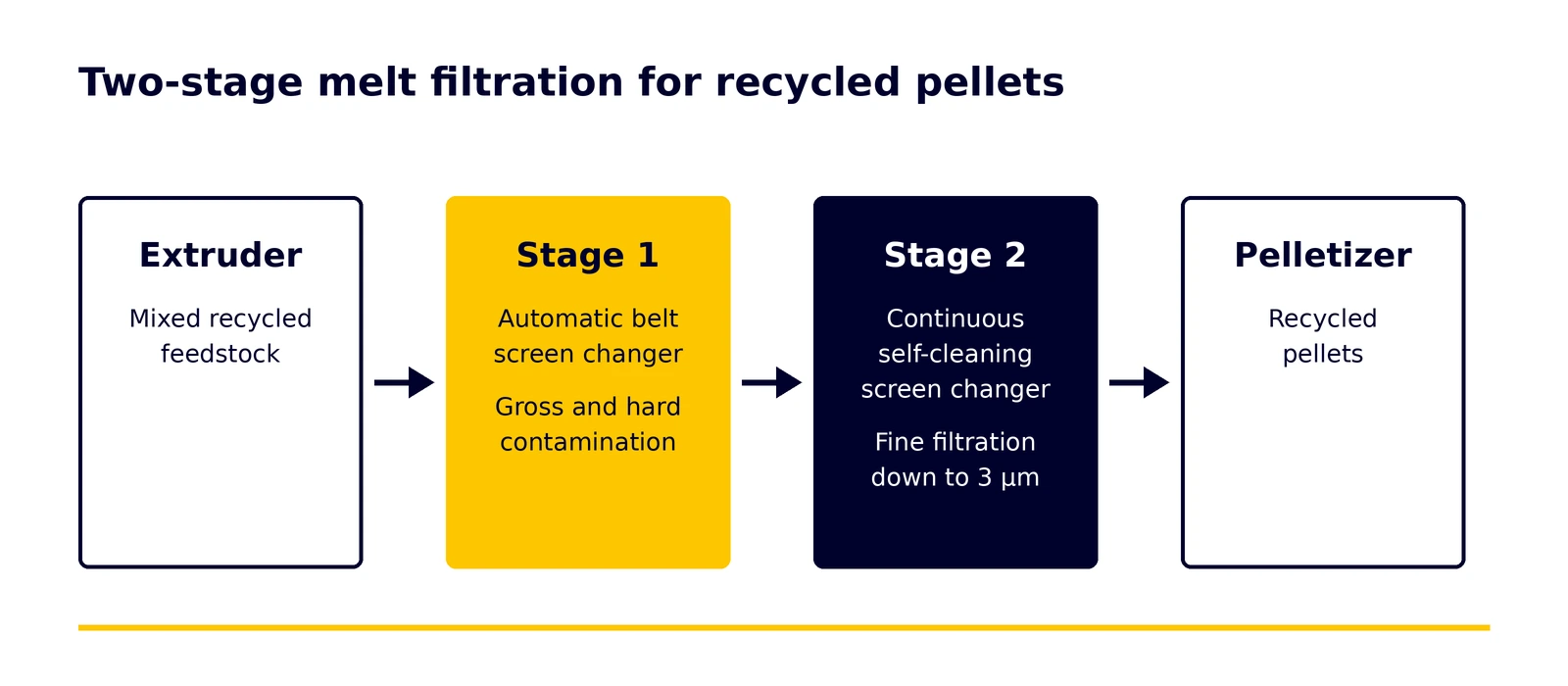
If the goal is to improve the quality of recycled plastic pellets from mixed waste, the most reliable continuous filtration setup is two stages in series. An automatic belt screen changer removes the gross and hard contamination first. A continuous self-cleaning screen changer then filters the much cleaner melt down to 3 μm, with melt pressure held within ±2%. The fine stage is protected from abrasive particles, and the coarse stage is not asked to deliver fine filtration it was not designed for.
A single stage is enough when the target is general-purpose recyclate and contamination stays within one technology’s range. Two stages pay off when pellets go into film, sheet or other applications where gels and black specks lead to rejected batches.
What the wrong choice costs
An undersized filter on a mixed recycling line shows up as unplanned stops, and an unplanned line stop typically costs $200–500 per hour. It also shows up in quality: pressure swings at each screen change let gels and specks through into the pellets.
Estimate how much output your line loses to screen changes with Cofit’s free calculator.
Use the savings calculatorFrequently asked questions
Sources and further reading
- Plastics Technology – Finding the Right Melt Filtration System for Post-Consumer Recycling
- Plastics Technology – Get Smarter About Melt Filtration
- Association of Plastic Recyclers – APR Design® Guide for Plastics Recyclability
- Cofit – Screen changers for extrusion and recycling
Not sure which filtration your mixed stream needs?
Send us your feedstock data – polymers, contamination level and type, throughput – and a Cofit engineer will tell you whether a belt, a self-cleaning or a two-stage solution fits your line.
Request a consultation Use the savings calculator
Cofit deals with research, engineering, manufacture and distribution of automatic and continuous screen changers for post-consumer and post-industrial recycling materials too.
Contact us to upgrade your extrusion system, ask us for more info about any product or service.