

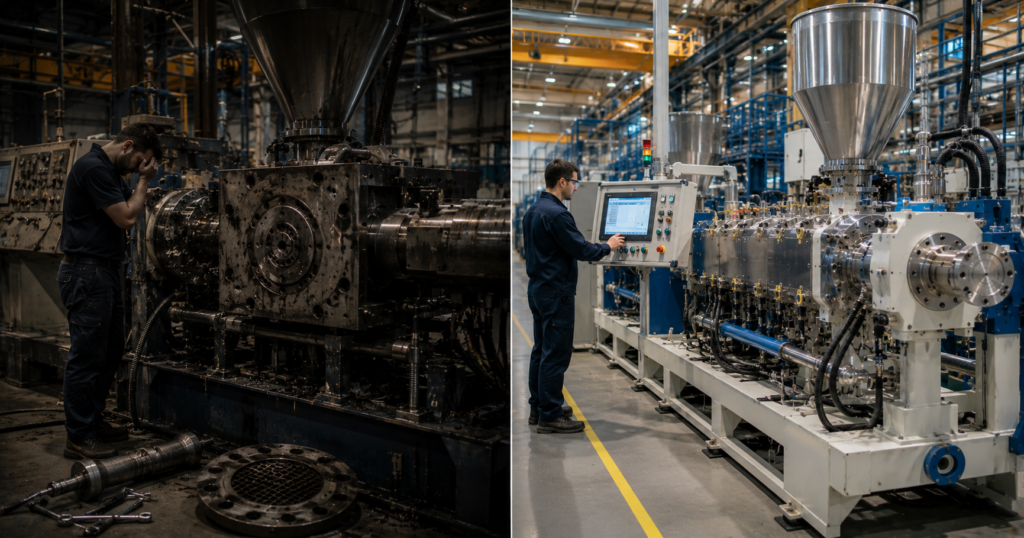
Continuous vs Discontinuous Screen Changer: Which One Do You Actually Need?
A continuous screen changer replaces or cleans the screen pack while the extruder runs — melt flow is never interrupted. A discontinuous screen changer requires the extruder to stop or significantly reduce output for screen replacement. Choose continuous when your line runs more than one screen change per shift, processes post-consumer recyclate, or produces film, fiber, or coating where pressure variation causes product defects. Choose discontinuous when screen life exceeds 12 hours, throughput is below 150 kg/h, and your product specification tolerates a restart pressure cycle.
When pressure variation is the core problem, the diagnostic path matters. See the complete guide to melt pressure instability: causes and solutions →
What the Terms Actually Mean
The terms “continuous” and “discontinuous” refer to the behaviour of melt flow through the screen changer during a screen change — not to the extruder screw rotation or the overall production run. In a discontinuous screen changer, melt flow is interrupted, reduced, or subjected to a significant pressure event when the screen pack is replaced. In a continuous screen changer, melt flow proceeds without interruption throughout the screen replacement or cleaning cycle.
This distinction matters because the melt flow interruption in a discontinuous system is not just a downtime event — it is a process disturbance that generates scrap, destabilises the bubble or die pressure, and requires a stabilisation period before the product is back within specification. Every discontinuous screen change is therefore a downtime event plus a quality event.
Discontinuous Screen Changers: The Three Types
Discontinuous screen changers cover a spectrum of disruption levels. The most basic type is a manual slide plate: the extruder is fully stopped, the barrel depressurised, and the screen pack physically pulled out and replaced. Changeover time is 30–60 minutes including cooling and restart. The second type is a hydraulic single-bolt screen changer: a hydraulic actuator slides the screen pack out and a fresh pack in within seconds, but melt pressure drops to near-zero during the transition and spikes on recovery — generating a brief but significant process disturbance. The third type is a hydraulic double-bolt (dual-slide) design, which maintains partial melt flow through one filtration channel while the other is changed, reducing but not eliminating the pressure event.
All three are classified as discontinuous because none maintains constant, uninterrupted melt flow at stable pressure through the screen change. The disruption differs in magnitude — from a full line stop (manual) to a sub-second pressure spike (dual-slide hydraulic) — but the disruption exists in all cases.
Screen Changers That Keep the Line Running
Continuous screen changers eliminate the melt flow interruption entirely. Two engineering approaches achieve this. The first is a self-cleaning cartridge design — the screen pack remains in the melt stream at all times. The AP Series operates on this principle: the operator uses a key to actuate the flow valves, and the resulting backflush of melt cleans the screen without stopping the line, while melt pressure remains within ±2% throughout. No screen is removed; no flow is interrupted.
The second is an automatic belt design — a filtration belt advances through the melt zone incrementally as each section reaches its particle capacity. The GorillaBelt operates on this principle: fresh belt feeds automatically from a supply roll, and saturated belt exits on the other side. There is no cleaning cycle and no screen pack to replace — the belt itself is the consumable. This design handles contamination levels that would overwhelm a self-cleaning system, making it the standard for post-consumer recycling streams.
Continuous vs Discontinuous Screen Changer: Full Comparison
The table below compares all major screen changer types across the dimensions that determine production economics and product quality.
| Criterion | DISCONTINUOUS | CONTINUOUS | |||
|---|---|---|---|---|---|
| Manual slide plate |
Hydraulic single-bolt |
Hydraulic dual-slide |
Self-cleaning (AP Series) |
Belt (GorillaBelt) |
|
| Production impact | |||||
| Melt flow during change | Full stop | Interrupted | Partial | Continuous | Continuous |
| Changeover time | 30–60 min | 5–30 sec | <1 min | Zero | Zero |
| Downtime per change | 30–60 min | 2–5 min restart | 1–3 min restart | None | None |
| Scrap at changeover | High | Moderate | Low–moderate | None | None |
| Annual downtime (3×/shift, 2 shifts)* | 750–1,500 h | 50–150 h | 25–75 h | ~0 h | ~0 h |
| Process quality | |||||
| Melt pressure at change | Full loss | Severe spike | Moderate spike | Stable ±2% | Stable |
| Gauge/dimensional variation | Severe at restart | Moderate | Low–moderate | None | None |
| Suitable for blown film / fiber | No | Limited | Marginal | Yes | Yes |
| Contamination handling | |||||
| Max contamination level | <0.5% | <1% | <2% | <1–2% | Up to 10% |
| Suitable for PCR recyclate | Not viable | Not viable | Low PCR only | Regrind or low recycled content | Up to 100% PCR |
| Economics | |||||
| Capital cost | Lowest | Low | Medium | Higher | Higher |
| Operating cost (high change freq.) | Very high | High | Moderate | Low | Low |
| Typical ROI vs manual (upgrade) | Baseline | — | — | 12–18 months | 12–24 months |
* Estimated annual downtime: 3 screen changes/shift × 2 shifts/day × 250 days/year. Actual figures depend on screen life and changeover duration.
Common Misconceptions About Screen Changer Types
“A hydraulic screen changer is basically continuous — the swap happens in seconds.”
The swap takes seconds, but melt pressure drops and spikes around it. On a blown film line, that pressure event destabilises the bubble for 2–10 minutes. The line is “running” but producing off-spec film.
“Continuous screen changers are only worth it on very high-throughput lines.”
The break-even depends on screen change frequency, not just throughput. A 200 kg/h line running 15% PCR recyclate may need 4–6 screen changes per shift — making continuous filtration the only viable option regardless of output rate.
“Self-cleaning screen changers work for any application, including high-contamination recycling.”
Self-cleaning systems have a cleaning rate limit. Above roughly 1–2% contamination by weight, the rate at which particles accumulate exceeds the rate at which the cleaning cycle removes them. Belt technology is required above this threshold.
“The ROI of continuous screen changers takes too long to justify the investment.”
On a line making 3 manual screen changes per 8-hour shift at $300/hour output value, the annual downtime cost exceeds $135,000. Most continuous screen changer upgrades pay back in 12–18 months on a single line, according to operating data from European extrusion converters.
Key Data Points and Benchmarks
The following benchmarks are based on industry operating data published by Plastics Technology, AMI Consulting, and the Plastics Industry Association (PLASTICS), and on process engineering experience across blown film, fiber, and recycling extrusion operations in Europe and North America.
| Metric | Value | Context | Source |
|---|---|---|---|
| Extrusion downtime cost | $200–$500 / line-hour | Across all thermoplastic extrusion line types | Plastics Technology |
| Manual screen change time | 15–45 min / change | Including depressurisation, swap, restart stabilisation | Industry standard |
| Discontinuous change frequency (PCR lines) | 4–12 changes / shift | At 3–8% contamination, 150-mesh filtration, 300 kg/h | AMI Consulting |
| Continuous filtration: pressure stability | ±2% melt pressure | During self-cleaning cycle — AP Series operating data | Cofit engineering data |
| OEE improvement: manual → continuous | +5–15% | Across blown film, cast film, and fiber spinning operations | PLASTICS / industry data |
| Downtime reduction: discontinuous → continuous | Up to 90% | On lines with >2 screen changes per shift | Cofit operating data |
| Max contamination: self-cleaning system (AP Series) | ~1–2% by weight | Above this, cleaning cycle cannot match accumulation rate | Process engineering consensus |
| Max contamination: belt system (GorillaBelt) | Up to 10% by weight | Post-consumer recyclate including metal, paper, foil | Cofit engineering data |
| Gauge variation reduction | 30–40% | Blown film lines upgrading from manual to continuous filtration | European converter operating data |
| Typical ROI payback period | 12–24 months | Single high-throughput extrusion line, >2 changes/shift | European converter case data |
What Do Your Screen Changes Cost Per Year?
Enter your throughput, stop frequency, and shift schedule. The Cofit Productivity Savings Calculator shows your monthly output loss and annual revenue impact in under two minutes.
When to Choose a Discontinuous Screen Changer
A discontinuous screen changer is the right choice when three conditions are met simultaneously: the polymer is clean (contamination below 0.5–1% by weight), screen life is long (8 hours or more per screen pack at the required filtration fineness), and the product specification tolerates the pressure events associated with a screen change. When these three conditions hold, the capital cost advantage of a discontinuous system is real and the operating cost difference is negligible.
Typical applications that meet these criteria: R&D and pilot extrusion lines, low-volume specialty profile and pipe production in short runs, compounding lines processing virgin polymer with stable formulations, and any line where the screen is changed less than once per shift. In these scenarios, the downtime cost of a discontinuous change is small relative to the line’s overall operating economics, and the capital saved by not installing a continuous system is difficult to justify recovering through reduced downtime.
“On our laboratory twin-screw line, we change the screen pack once a week,” notes a compounding process engineer at a specialty polymer operation. “A continuous self-cleaning system would never pay for itself there. The manual hydraulic we have is the right tool.”
When to Choose a Continuous Screen Changer
A continuous screen changer becomes the economically and technically correct choice when any one of the following conditions is present: the line makes more than one screen change per shift, the polymer contains post-consumer recyclate above 10% content, the product is a film, fiber, or coating where melt pressure variation causes dimensional or surface defects, or the line runs more than one shift per day at throughputs above 150–200 kg/h.
For the PET-specific version of this challenge, see the guide to PET recycling filtration.
The trigger is rarely all conditions at once. A single-shift film line at 250 kg/h running 100% virgin LDPE with screen life of 6 hours still clears the threshold: one change per 6-hour working period means roughly 1.3 changes per shift. At 20 minutes per change, that is 26 minutes of downtime per shift, 104 minutes per 4-shift day, and 433 hours per year. At $250/hour output value, the annual downtime cost alone exceeds $108,000 — more than enough to justify continuous filtration.
For lines processing post-consumer recyclate above 15–20% content, the decision is not economic — it is operational. At contamination levels of 3–8% by weight, discontinuous systems require screen changes at intervals that make continuous operation impossible to maintain. As AMI Consulting’s recycling stream data documents, the screen change frequency on a 300 kg/h blown film line running 30% PCR content with 4% contamination at 150-mesh filtration reaches 6–10 changes per 8-hour shift. No manual system can sustain this — the line would spend more time in changeover than in production. Evaluating specific suppliers? See the Nordson screen changer alternatives guide →
Self-Cleaning vs Belt: The Secondary Decision
Once the decision to go continuous is made, the secondary choice between self-cleaning cartridge systems and belt systems is determined by contamination level alone. Below approximately 1–2% contamination by weight of the total melt stream, a self-cleaning system such as the AP Series maintains the screen indefinitely. Above 1–2%, the particle accumulation rate begins to exceed the cleaning cycle capacity — at 5–8%, the self-cleaning system enters a losing battle where it cleans continuously but still trends toward saturation. Belt technology, which never cleans and never saturates, is the correct solution above this threshold.
How to Calculate the Cost of Your Current Screen Change Frequency
The economic case for upgrading from a discontinuous to a continuous screen changer is a straightforward calculation with four inputs. You do not need a consultant or an ROI model — you need four numbers that any production manager can read from the shift log.
The formula: (Changes/shift × Minutes/change × Shifts/day × Operating days/year) ÷ 60 × Throughput × Output value = Annual output loss. For a line at 3 changes/shift × 20 min × 2 shifts × 250 days = 500 hours of downtime × 350 kg/h × €2.00/kg = €350,000/year in lost output — before scrap and quality costs.
The Cofit Productivity Savings Calculator runs this calculation for your specific parameters in under two minutes and shows monthly and annual figures side by side.
Cofit Screen Changers
Three Cofit product families: the AP Series for fine filtration applications, GorillaBelt for high-contamination recycling streams and ScrapeAway, an automatic, continuous and self-cleaning laser melt filter for solid contaminants such as aluminium and elastomers. All three eliminate the screen change downtime that discontinuous systems cannot avoid.
The screen is cleaned in place while the line runs. No stops, no pressure spikes, melt pressure stable within ±2% throughout the cleaning cycle. Suitable for blown film, cast film, stretch film, fiber spinning, sheet, extrusion coating, and compounding with virgin polymer, regrind or low recycled content.
For fine-mesh applications in particular, see the wire, cable & fiber extrusion filtration guide →
AP Series specifications →Fresh belt advances automatically through the melt zone — no cleaning cycle, no saturation limit. Handles contamination up to 10% by weight. The correct choice when self-cleaning capacity is exceeded: metal fragments, aluminium foil, paper, cross-linked polymer at high concentration.
GorillaBelt specifications →Two laser-drilled filter discs, fixed scrapers and an automatic discharge system remove contaminants without stopping the line. For contaminated recycled melts with solid contaminants such as aluminium and elastomers.
- Filtration 100–1,000 µm
- Up to 5,000 kg/h per unit
- Up to 250 bar and 300 °C
- Melt loss below 1%
Frequently Asked Questions
A continuous screen changer maintains uninterrupted melt flow through the screen replacement or cleaning process — the extruder never stops and melt pressure remains stable. A discontinuous screen changer interrupts melt flow when the screen pack is replaced: this ranges from a full extruder stop (manual systems, 30–60 minutes) to a brief pressure spike (hydraulic systems, seconds of disruption but minutes of stabilisation). The distinction matters because the flow interruption in a discontinuous system generates scrap, destabilises pressure-sensitive processes such as blown film and fiber spinning, and represents direct production loss every time it occurs.
A discontinuous screen changer is sufficient when three conditions are met simultaneously: the polymer contamination level is below 0.5–1% by weight, screen life at the required filtration fineness is 8 hours or more per screen pack, and the product specification tolerates the pressure events and dimensional variation associated with a screen change. Applications that typically meet these criteria include R&D lines, low-volume specialty profile and pipe extrusion in short runs, virgin-polymer compounding with stable formulations, and any line that changes screens less than once per shift. Outside these conditions, the operating cost of a discontinuous system exceeds the capital cost difference within 12–24 months.
The economic break-even is typically reached at one or more screen changes per shift. At one change per shift of 20 minutes at $300/hour line value, the annual downtime cost is approximately $25,000 on a single-shift operation. At two changes per shift on a two-shift operation, the annual cost exceeds $100,000 — a level at which most continuous screen changer investments pay back in under 18 months. The Cofit Productivity Savings Calculator quantifies this precisely for your throughput, changeover time, and output value. As a rule of thumb, any line exceeding 1.5 changes per shift is a strong candidate for a continuous system.
A self-cleaning continuous screen changer handles post-consumer recyclate (PCR) content effectively up to approximately 1–2% contamination by weight of the total melt stream. At this contamination level, the mechanical cleaning cycle can remove particles from the screen surface faster than they accumulate, maintaining stable filtration area and constant differential pressure. Above 1–2% contamination — typical of mixed post-consumer LDPE film at 30% or more PCR content — the accumulation rate exceeds the cleaning capacity and the system trends toward saturation despite continuous cleaning. Belt screen changers such as the GorillaBelt, which advance fresh belt rather than cleaning an existing screen, handle contamination up to 10% by weight without this limitation.
In most cases, a continuous screen changer installs in the same position in the extrusion line as an existing screen changer or breaker plate assembly — between the extruder barrel outlet and the die adapter — without modifications to the extruder itself. The connection flanges and the melt channel diameter must be matched to the existing line geometry, which is standard engineering in a screen changer replacement project. Lines may require minor adjustments to the die adapter or pipe connections to accommodate the physical footprint of a continuous system, which is larger than a manual slide plate. A Cofit process engineer reviews the line geometry during technical alignment to confirm fit before any equipment is specified.
Sources and References
- Plastics Technology — extrusion downtime cost benchmarks ($200–$500/line-hour)
- AMI Consulting — post-consumer recyclate contamination data (3–8% by weight); PCR screen change frequency on blown film lines
- Plastics Industry Association (PLASTICS) — OEE improvement data for filtration technology upgrades (5–15%)
- Harper, Charles A. (ed.) — Handbook of Plastics Technologies — screen changer operating principles and melt pressure ranges
- European flexible packaging converter operating data — gauge variation reduction (30–40%) after upgrading from manual to continuous filtration
- Cofit International engineering data — AP Series melt pressure stability (±2%), GorillaBelt contamination tolerance (up to 10% by weight), downtime reduction up to 90%
Find Out What Your Screen Changes Are Costing You — in Two Minutes
Enter your throughput, screen change frequency, and shift schedule. The Cofit Productivity Savings Calculator shows your monthly output loss and the annual revenue you are leaving on the table.
Cofit deals with research, engineering, manufacture and distribution of automatic and continuous screen changers for post-consumer and post-industrial recycling materials too.
Contact us to upgrade your extrusion system, ask us for more info about any product or service.