

Wire, Cable & Fiber Extrusion Filtration: The Complete Guide
Wire, cable, and fiber extrusion require the finest melt filtration specifications in thermoplastics processing. Fiber spinning demands very fine filtration to protect spinnerets from micro-contaminants that cause filament breaks; cable insulation extrusion requires defect-free melt to prevent voids and pin-holes that fail electrical testing. Both applications require continuous self-cleaning filtration — at 270–400 mesh (37–53 μm), screen pack saturation occurs too rapidly for manual changes to be operationally sustainable.
Why Wire, Cable, and Fiber Extrusion Set the Highest Filtration Standards
Wire, cable, and fiber extrusion share a defining characteristic that sets them apart from film, sheet, and pipe applications: the die geometry is extremely small relative to the melt volume processed. A spinneret for multifilament fiber production contains hundreds or thousands of very small holes. A cable insulation die has a thin, precision-machined annular gap. Any solid particle that reaches these dies either blocks a hole — causing a filament break or a surface defect — or creates a localised restriction that distorts the geometry of the entire cross-section.
The consequence is that filtration fineness requirements in these applications are the strictest in polymer extrusion. Where blown film operates comfortably at 100–200 mesh (74–149 μm), fiber spinning requires 270–400 mesh (37–53 μm) and fine denier multifilament may require sub-30 μm filtration. At these mesh counts, differential pressure (ΔP) across the screen pack rises significantly faster than in film applications — making the choice of screen changer technology a critical process engineering decision, not an ancillary equipment specification.
Filament breaks are a major cause of production loss in fiber spinning, and most trace back to contamination above the spinneret’s critical particle size. For cable insulation, voltage breakdown and dielectric strength tests under IEC standards are particularly sensitive to voids and inclusions in the insulation wall, both of which originate from melt contamination reaching the die.
The Shared Challenge: Rapid Screen Saturation at Fine Mesh
The engineering challenge in wire, cable, and fiber filtration is not achieving the required fineness — it is sustaining it in production. At 325 mesh (44 μm), screen packs on a multifilament spinning line can saturate within hours, making frequent manual changes unavoidable.
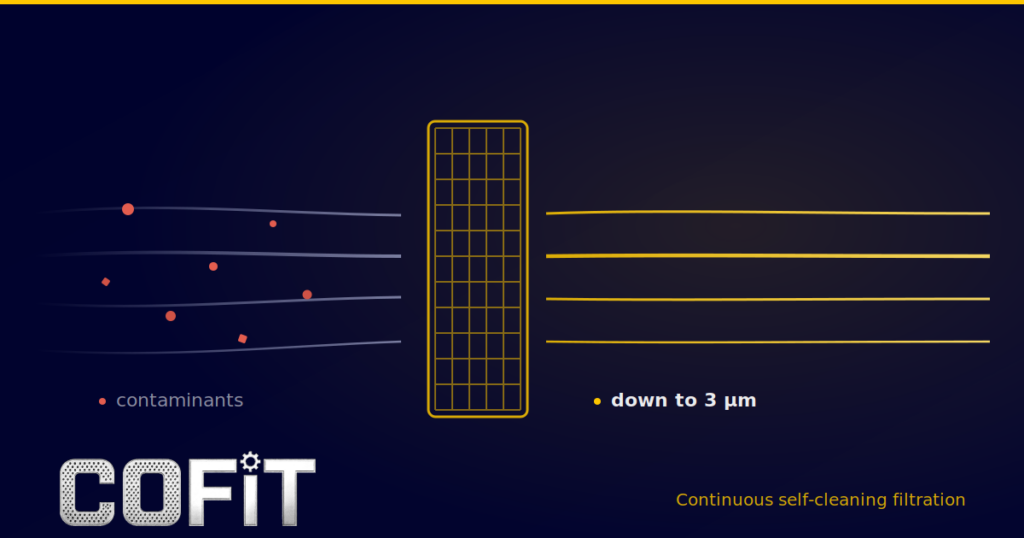
Continuous self-cleaning filtration resolves this by cleaning the screen in place before it approaches saturation, maintaining a stable filtration area and a stable ΔP. The AP Series filters down to 3 μm, continuously, without production interruption. For wire and fiber lines, it is a practical requirement for running fine filtration in production.
Fiber Spinning: Melt Filtration Requirements by Application
Fiber spinning encompasses a wide range of polymer types and end-use applications — from commodity polyester staple fiber to high-tenacity industrial yarn and ultra-fine microfiber. Each application has a distinct filtration requirement driven by the spinneret geometry, the target fiber denier, and the end-use quality specification. The table below maps the principal fiber applications to their filtration specifications.
| Application | Polymer | Fiber denier | Mesh range | Aperture (μm) | Critical requirement |
|---|---|---|---|---|---|
| Polyester staple fiber | PET | 1.5–6 dpf | 200–270 mesh | 53–74 μm | Spinneret protection, filament uniformity |
| Polyester multifilament (textile) | PET | 0.5–3 dpf | 270–325 mesh | 44–53 μm | Zero filament breaks, tenacity consistency |
| Nylon 6 / Nylon 6,6 multifilament | PA6, PA66 | 1–5 dpf | 270–400 mesh | 37–53 μm | Spinneret protection, dye uniformity |
| Polypropylene spunbond / nonwoven | PP | 1.5–4 dpf | 200–270 mesh | 53–74 μm | Web uniformity, filament continuity |
| Microfiber / ultra-fine filament | PET, PA | <0.5 dpf | 400+ mesh | <37 μm | Extreme spinneret protection — any inclusion fatal |
| Industrial yarn (tyre cord, seatbelt) | PET, PA66 | 5–10 dpf | 250–325 mesh | 44–61 μm | Tensile strength consistency, zero breaks |
Aperture values based on ASTM E11 plain weave nominal specification. dpf = denier per filament. Specifications are engineering guidance ranges.
Why Spinneret Protection Requires Continuous Filtration
A multifilament spinneret contains a large number of precision-machined holes. A single contamination particle above a critical fraction of the hole diameter blocks the hole and severs the filament, creating a quality defect in the yarn bundle; several blocked holes mean a product failure.
At 325 mesh, screen life on a PET multifilament line is short enough that a line running around the clock would need several screen changes a day — each one generating scrap during pressure recovery and re-stabilisation.
Wire & Cable Insulation Extrusion: Filtration for Electrical Performance
Cable insulation extrusion applies a layer of thermoplastic insulation, such as PE or PP, over a conductor. In all cases, the electrical performance of the finished cable depends entirely on the dielectric integrity of the insulation — and dielectric integrity is compromised by any void, inclusion, or contamination event in the melt that reaches the crosshead die.
Voltage breakdown tests on extruded low-voltage power cables, such as those under IEC 60502, are sensitive to small inclusions in the insulation wall, which can also act as partial discharge initiation sites.
Screen Pack Specification for Cable Insulation
For low-voltage power cable and telecom or data cable jackets, 150–200 mesh (74–105 μm) is a typical engineering specification; the final choice depends on the compound and the quality requirements of the cable.
What Is Your Screen Change Frequency Costing You?
Enter your fiber or cable line throughput, screen change frequency, and shift schedule. The calculator shows your monthly lost production and its annual value in under two minutes.
Screen Changer Selection for Wire, Cable, and Fiber Lines
The filtration fineness required for wire, cable, and fiber applications — 200 to 400+ mesh — eliminates discontinuous screen changers as a practical option above moderate throughputs. At 325 mesh, the cycle from clean screen to saturation on a fiber spinning line is short, and the production lost to screen changes and restart stabilisation makes manual changing unsustainable for 24/7 production.
Continuous self-cleaning filtration is therefore the preferred technology for high-throughput fiber spinning, cable insulation, and wire coating lines. The continuous vs discontinuous screen changer guide covers the decision framework in detail — for wire, cable, and fiber at standard throughputs, the decision is effectively made by the application requirement.
The No-Hydraulic-Unit Advantage for Fiber and Cable Lines
Fiber spinning and cable insulation extrusion lines are typically space-constrained: multiple extruders, godets, quench baths, and winders occupy the available floor area. The AP Series works without hydraulic systems, which is operationally significant in retrofit situations where utility connections and floor space are fixed constraints.
Melt Pressure Stability and Its Effect on Fiber Denier and Cable Wall Thickness
Melt pressure instability from screen pack saturation affects wire and fiber products in the same way it affects film — through dimensional variation. In fiber spinning, pressure variation upstream of the spinneret produces denier variation across the filament bundle. In cable insulation, it produces wall thickness variation around the circumference of the cable. Both are quality failures: denier variation causes uneven dyeing in textile fiber; wall thickness variation in cable insulation creates thin spots that reduce breakdown voltage below specification.
Continuous self-cleaning filtration — keeping melt pressure stable — keeps these dimensional variations to a minimum.
The Economics of Filtration on Fiber and Cable Lines
The economic case for continuous filtration on fiber and cable lines is driven by three components: direct downtime from screen changes, scrap generated during pressure stabilisation after each change, and quality rejects from filament breaks or cable insulation defects caused by pressure instability.
The cost is easy to quantify: screen changes per shift × minutes per stop × shifts × operating days ÷ 60 × throughput gives the output the line loses every year to screen changes — before scrap during pressure recovery and quality rejects. The calculator does this with your own line data in under two minutes.
Cofit AP Series for Wire, Cable, and Fiber Extrusion
The AP Series continuous self-cleaning screen changer is the filtration solution for fine-filtration applications in fiber spinning, cable insulation, and wire coating — where sustained operation at 200–400+ mesh without production interruption is the engineering requirement.
- Fiber spinning: polyester, nylon, polypropylene — all denier ranges
- Cable insulation: PE, PP
- Wire coating: automotive wire, data cable
- Max operating pressure: above 500 bar
- Cleaning: backflush activated by the operator with a key
Frequently Asked Questions
Filtration fineness for fiber spinning depends on the fiber denier and spinneret geometry. Standard polyester staple fiber (1.5–6 dpf) requires 200–270 mesh (53–74 μm, ASTM E11). Multifilament textile grades (0.5–3 dpf) in polyester and nylon require 270–325 mesh (44–53 μm). Microfiber and ultra-fine filament below 0.5 dpf require 400+ mesh (below 37 μm). Industrial yarn for tyre cord and seatbelt applications — where tensile consistency is critical — specifies 250–325 mesh (44–61 μm). The critical constraint is always the spinneret hole diameter: particles above a critical fraction of the hole diameter risk blocking individual holes and causing filament breaks. For mesh-to-micron conversions across all these specifications, see the Cofit Mesh-to-Micron Converter.
At the filtration fineness required for fiber spinning (270–400 mesh), screen packs saturate within hours at typical production throughputs, and every manual change costs production in changeover and stabilisation. Continuous self-cleaning filtration maintains a constant filtration area and stable melt pressure without any production stops — for fine filtration applications, this is a practical requirement for sustaining production. Manual screen changing at 325 mesh is operationally viable only on very low throughput or development lines.
Melt pressure instability from screen pack saturation produces denier variation across the filament bundle in fiber spinning — analogous to gauge variation in film extrusion. Rising ΔP as the screen saturates reduces effective melt pressure at the spinneret, lowering the output rate per hole and producing finer-than-specified filaments. When the screen is replaced and pressure restores, the output rate increases and filaments become coarser. The result is a denier variation pattern along the yarn length that causes uneven dyeing in textile applications and tensile inconsistency in technical yarn. Continuous self-cleaning filtration greatly reduces this variation source.
Yes, in most cases. The AP Series installs in the same position as an existing screen changer or breaker plate assembly — between the extruder barrel outlet and the die adapter or crosshead — usually with limited modifications. The flange geometry must be confirmed against the existing line drawings before specifying the replacement unit. The AP Series does not require a hydraulic power unit, which significantly simplifies retrofit installation on lines where floor space and utilities are constrained. A Cofit process engineer reviews line geometry and specifies the correct configuration before any equipment is ordered.
Find Out What Screen Changes Are Costing Your Fiber or Cable Line
Enter your throughput, screen change frequency, and shift schedule. The calculator shows your monthly lost production and its annual value in under two minutes. Or speak directly with a Cofit engineer about filtration specification for your application.
Cofit deals with research, engineering, manufacture and distribution of screen changers that keep the line running, including for post-consumer and post-industrial recycled materials.
Contact us to upgrade your extrusion system or ask us for more information about any product or service.