

Breaker Plate vs Screen Changer: What's the Difference and When Does It Matter?
A breaker plate is a structural component. A screen changer is a filtration system. Every extruder has a breaker plate; not every extruder has a screen changer. Confusing the two is one of the most common specification errors in extrusion line design — and it costs production.
What Is a Breaker Plate?
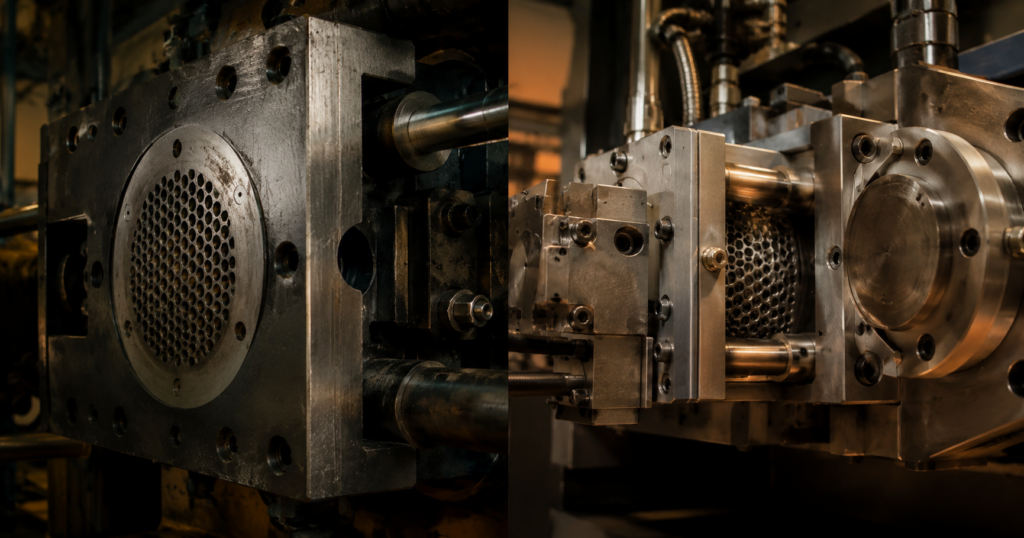
A breaker plate — also called a screen support plate or adapter plate — is a thick, perforated disc of hardened stainless steel installed at the exit of the extruder barrel, immediately before the die adapter. Its primary function is structural: it supports the screen pack under the high melt pressure generated by the extruder screw, which typically ranges from 100 to 400 bar in standard thermoplastic processing.
Without a breaker plate, the wire mesh screen pack — which is made of relatively fine wire — would deform and rupture under melt pressure within minutes. The breaker plate’s perforations (typically 4–8 mm diameter holes, covering 30–40% of the plate surface) allow the polymer melt to pass through while distributing the pressure load across the plate’s full cross-section.
The breaker plate also performs a secondary function: it disrupts the rotational flow pattern imparted to the melt by the extruder screw, converting it into a more uniform, linear flow profile as it enters the die. This is why the component is sometimes called a “flow straightener” in older technical literature. According to the Handbook of Plastics Technologies (Harper, ed.), breaker plates have been a standard component in single-screw extrusion since the 1940s.
What Is a Screen Changer?
A screen changer is a complete filtration system that includes the screen pack, the breaker plate, and — critically — the mechanism to replace or clean the screen pack without stopping melt flow. It is installed in the same position in the extrusion line: between the extruder barrel and the die. But where a breaker plate is a passive structural component, a screen changer is an active system.
The screen changer’s defining feature is its changeability: it allows operators to replace saturated screen packs — either by stopping the line briefly (discontinuous designs) or with no interruption whatsoever (continuous designs). A screen changer without a screen pack is just a housing; a screen pack without a screen changer mechanism is just a breaker plate assembly.
In practice, the term “breaker plate” is often used informally to describe a basic manual screen changer — a slide plate with a breaker plate and screen pack that can be pulled out and replaced when the line is stopped. This usage creates significant confusion when specifying equipment, because the performance gap between a passive breaker plate, a manual slide-plate screen changer, and a continuous self-cleaning screen changer is enormous.
Breaker Plate vs Screen Changer: Side-by-Side Comparison
The table below compares a fixed breaker plate assembly, a manual slide-plate screen changer, and a continuous self-cleaning screen changer across the dimensions that matter most for production planning.
| Feature | Fixed breaker plate | Manual screen changer | Continuous screen changer (AP Series) |
|---|---|---|---|
| Primary function | Screen support + flow straightening | Filtration + manual screen replacement | Continuous filtration + self-cleaning by backflush |
| Screen replacement | Full line stop required | Brief stop or flow reduction | No stop — continuous |
| Changeover time | 30–60 min (cool-down + restart) | 15–45 min | Zero (no line stop) |
| Melt pressure during change | Full pressure loss | Spike at screen swap | Stable within ±2% |
| Scrap at changeover | High — full restart purge | Moderate — pressure spike recovery | None |
| Filtration fineness range | Any mesh — but no online change | Any mesh — changed offline | Any mesh — maintained continuously |
| Operator intervention frequency | Every screen life cycle — full stop | Every 2–24 h depending on contamination | Minimal — the operator actuates the flow valves with a key |
| Suitable for recyclate / regrind | Not viable | Limited — very frequent stops | Regrind or low recycled content |
| OEE impact vs baseline | Baseline (worst) | Moderate improvement | +5–15% vs manual |
| Capital cost | Lowest | Low–moderate | Higher upfront — ROI typically 12–18 months |
How a Breaker Plate Works in an Extruder
The breaker plate sits in a housing at the discharge end of the extruder barrel. Polymer melt — under pressure from the rotating screw — is forced through the plate’s perforations. The screen pack, sandwiched between the breaker plate and the upstream face of the die adapter, performs the actual filtration. The breaker plate carries the pressure load; the screen does the filtering.
In a fixed breaker plate assembly, the plate and screen pack are a single unit bolted into the extruder head. When the screen pack reaches saturation — indicated by rising upstream melt pressure — the entire assembly must be removed, cooled, disassembled, cleaned, repacked with fresh screens, and reinstalled. This process requires a full line stop and typically takes 30–60 minutes including cool-down and restart time.
The flow-straightening function is real but secondary. The rotation of the extruder screw imparts a helical velocity component to the melt. The breaker plate disrupts this by forcing the melt through hundreds of small holes — each hole acts as a mini-channel that realigns the flow axially. The die geometry handles the final flow distribution. In most modern extruder designs, the flow-straightening role of the breaker plate is considered less critical than its screen-support function.
How a Screen Changer Improves on a Fixed Breaker Plate
A screen changer replaces the fixed breaker plate assembly with a housing that contains one or more breaker plates — and adds the mechanism to move, clean, or replace them without stopping melt flow. The core engineering insight is that screen saturation is a predictable, recurring event: designing the line to handle it without stopping is a straightforward productivity decision.
In a manual slide-plate screen changer, the breaker plate sits in a hydraulically actuated slide that can be moved sideways under load. When the operator triggers a change, the slide shifts: the saturated screen moves out of the melt stream and a fresh screen moves in. The transition takes seconds, but melt pressure fluctuates during the swap — sometimes significantly — which generates scrap in pressure-sensitive applications like blown film.
In a continuous self-cleaning screen changer such as the AP Series, the screen pack is never removed from the melt stream. Instead, the operator uses a key to actuate the flow valves: the resulting backflush of melt cleans the screen without stopping the line. Melt pressure remains within ±2% throughout the cleaning cycle. No scrap is generated. The line runs.
The Real Cost of Running on a Breaker Plate Alone
The decision to run a line with only a fixed breaker plate — or with a basic manual screen changer — is not a neutral choice. It has a measurable operating cost that compounds with every shift.
According to figures published by Plastics Technology, unplanned extrusion downtime costs between $200 and $500 per line-hour on average. A line running at 350 kg/h that requires three manual screen changes per 8-hour shift — at 20 minutes each — loses 60 minutes of production per shift. That is 12.5% of daily capacity, before accounting for the scrap generated during pressure recovery after each change.
Annualised over 250 operating days and two shifts per day, that is 500 hours of lost production. At a conservative output value of €2.00/kg and 350 kg/h throughput, the annual output loss from screen changes alone reaches €350,000.
(3 × 20-min changes)
(2 shifts, 250 days)
@ 350 kg/h, €2/kg
to continuous filtration
These figures reflect a moderate-contamination scenario. On post-consumer recyclate lines where contamination reaches 3–8% by weight, screen life drops to 2–4 hours — tripling or quadrupling the downtime exposure.
“The decision point is usually when the production manager looks at the shift log and counts the stops,” says a process engineer specialising in flexible packaging extrusion. “When you see six entries for screen changes in a 24-hour period, the economics of continuous filtration become impossible to ignore.”
Calculate Your Annual Screen Change Cost
Enter your throughput, stop frequency, and shift schedule. See your monthly lost production and the revenue you are leaving on the table — in under two minutes.
When to Use a Breaker Plate Only
A fixed breaker plate assembly is appropriate in a narrow set of scenarios: lines running virgin polymer with extremely low contamination levels (below 0.1% by weight), throughputs below 100 kg/h, screen life measured in days rather than hours, and product specifications that tolerate a full line stop for screen replacement. This profile describes laboratory extruders, small-scale R&D lines, and certain specialty compounding operations where runs are short and material is clean.
It also describes a historical baseline. Many extrusion lines installed before the 1990s were designed around fixed breaker plates because continuous screen changers were not yet commercially available at competitive cost. Plants still operating this equipment are not running an intentional design choice — they are running legacy infrastructure.
If your line makes more than one manual screen change per shift, a fixed breaker plate assembly is costing you measurable production. The only question is whether the cost of the upgrade is justified by the output recovery — and for most lines running at 200 kg/h or above, it is.
When to Upgrade to a Screen Changer
The upgrade from a fixed breaker plate or manual screen changer to a continuous self-cleaning system is justified when any of the following conditions are present: throughput above 200 kg/h, more than one screen change per shift, product quality sensitive to melt pressure variation (blown film, cast film, fiber, extrusion coating), or polymer containing regrind or post-consumer recyclate above 1% contamination by weight.
The AMI Consulting European Flexible Packaging report notes that continuous filtration technology adoption has accelerated significantly among converters processing higher recycled content — driven both by economics and by sustainability mandates requiring minimum recycled content percentages in finished packaging. Continuous screen changers are the enabling technology for running elevated recyclate content without proportionally increasing downtime.
Evaluating a specific supplier? See Nordson screen changer alternatives →
For post-consumer recycling applications specifically — where contamination reaches 3–8% by weight and screen life can drop below two hours — automatic belt-type screen changers such as the GorillaBelt handle contamination levels up to 10% by weight without any pressure disturbance or manual intervention. The engineering requirement at this contamination level is not just “continuous” filtration but a design capable of managing very high particle loads without any cleaning cycle limitation.
For the complete engineering guide to polymer melt filtration — including contaminant types, differential pressure management, and technology selection — see the full guide.
The Breaker Plate Inside a Screen Changer
It is worth clarifying one point of persistent confusion: every screen changer contains a breaker plate. The breaker plate does not disappear when you upgrade — it becomes part of the screen changer housing, fulfilling the same structural and flow-straightening functions as always. What you add is the mechanism to change or clean the screen pack while the plate remains in the melt stream.
This means that upgrading from a fixed breaker plate to a continuous screen changer does not sacrifice any of the process benefits of the breaker plate. You gain the ability to maintain continuous filtration without losing the structural support, pressure management, and flow conditioning that the breaker plate provides. The screen changer is the breaker plate — plus the mechanism that makes it productive.
Cofit Screen Changers
Three Cofit product families: the AP Series for fine-filtration extrusion applications, GorillaBelt for post-consumer recycling and ScrapeAway, an automatic, continuous and self-cleaning laser melt filter for solid contaminants such as aluminium and elastomers. All three eliminate the line stops that a fixed breaker plate assembly cannot avoid.
Continuous self-cleaning filtration for blown film, cast film, stretch film, fiber spinning, sheet, extrusion coating, and compounding. The screen is cleaned in place — the line never stops. Melt pressure held within ±2% throughout the cleaning cycle.
AP Series specifications →Automatic melt filtration system for post-consumer and industrial recyclate. Handles contamination up to 10% by weight — the level that saturates self-cleaning systems. Belt advances automatically through the melt zone; no cleaning cycle, no pressure disturbance, no stops.
GorillaBelt specifications →Two laser-drilled filter discs, fixed scrapers and an automatic discharge system remove contaminants without stopping the line. For contaminated recycled melts with solid contaminants such as aluminium and elastomers.
- Filtration 100–1,000 µm
- Up to 5,000 kg/h per unit
- Up to 250 bar and 300 °C
- Melt loss below 1%
Not sure which applies to your process? See the full Screen Changers guide or use the Mesh-to-Micron Converter to confirm your filtration fineness specification.
Frequently Asked Questions
A breaker plate is a perforated stainless steel disc that supports the wire mesh screen pack under melt pressure (typically 100–400 bar) and straightens melt flow at the exit of the extruder barrel. A screen changer is a complete system that includes the breaker plate and adds the mechanism to replace or clean the screen pack — either with a brief line stop (manual/hydraulic designs) or with no interruption at all (continuous self-cleaning designs). Every screen changer contains a breaker plate; a standalone breaker plate assembly has no screen-changing mechanism.
You can run an extruder with only a fixed breaker plate assembly — and many lines do. But every screen change requires a full line stop: the barrel pressure must drop, the breaker plate assembly must be removed, cooled, disassembled, repacked with fresh screens, reinstalled, and the line restarted. This takes 30–60 minutes per change. On a line making two to four screen changes per shift, that is 60–240 minutes of downtime — 12–50% of shift capacity — before accounting for scrap at restart. Whether this is acceptable depends on your throughput, screen life, and the output value of the line.
A breaker plate in extrusion serves two functions. Its primary function is structural: it supports the wire mesh screen pack under the high melt pressure generated by the extruder screw, preventing the screen from deforming and rupturing. Its secondary function is flow conditioning: the plate’s perforations disrupt the rotational flow pattern imparted by the screw, converting it into a more linear, uniform flow profile before it enters the die adapter. In modern extruder designs with well-designed die adapters, the flow-conditioning role is secondary to the structural support function.
The breaker plate itself — the steel disc — has a very long service life and typically does not need replacement unless it is physically damaged, corroded, or deformed by abnormal pressure events. What needs regular replacement is the screen pack seated against the breaker plate: the wire mesh filter elements. Screen pack life depends entirely on the polymer being processed and its contamination level. In virgin LDPE blown film, screen life may be 12–24 hours at 150 mesh. In post-consumer recyclate with 5% contamination, it may be 1–3 hours at the same fineness. The screen changer — not the breaker plate — is the engineering solution to frequent screen replacement.
Yes. A continuous screen changer — including self-cleaning designs such as the AP Series — contains breaker plates as structural components within the screen changer housing. The breaker plate’s role (supporting the screen pack under melt pressure) is unchanged. What changes is the screen replacement mechanism: instead of removing the breaker plate assembly from the line, the screen is cleaned in place or advanced automatically while the breaker plate remains in the melt stream. You gain the screen-changing capability without losing any of the structural or flow-conditioning benefits of the breaker plate.
Find Out What Your Screen Changes Are Costing You
Enter your line throughput, stop frequency, and shift schedule. The Cofit Productivity Savings Calculator shows your monthly output loss and annual revenue impact in under two minutes.
Cofit deals with research, engineering, manufacture and distribution of automatic and continuous screen changers for post-consumer and post-industrial recycling materials too.
Contact us to upgrade your extrusion system, ask us for more info about any product or service.