

How to Choose Melt Filtration for Mixed Post-Consumer and Post-Industrial Plastic Waste
Direct answer
For mixed post-consumer and post-industrial plastic waste, choose melt filtration for the dirtiest batch in the blend, not for the average or for the stream label: how much contamination it carries, what type of contamination it is and what pellet quality you need. For recycled PET, Cofit’s solution is ScrapeAway, an automatic, continuous and self-cleaning laser melt filter. For other contaminated recycled melts, Cofit offers GorillaBelt and ScrapeAway. GorillaBelt is an automatic melt filtration system that handles contamination up to 10% by weight. Not sure which system fits your process? Request a Technical Alignment.
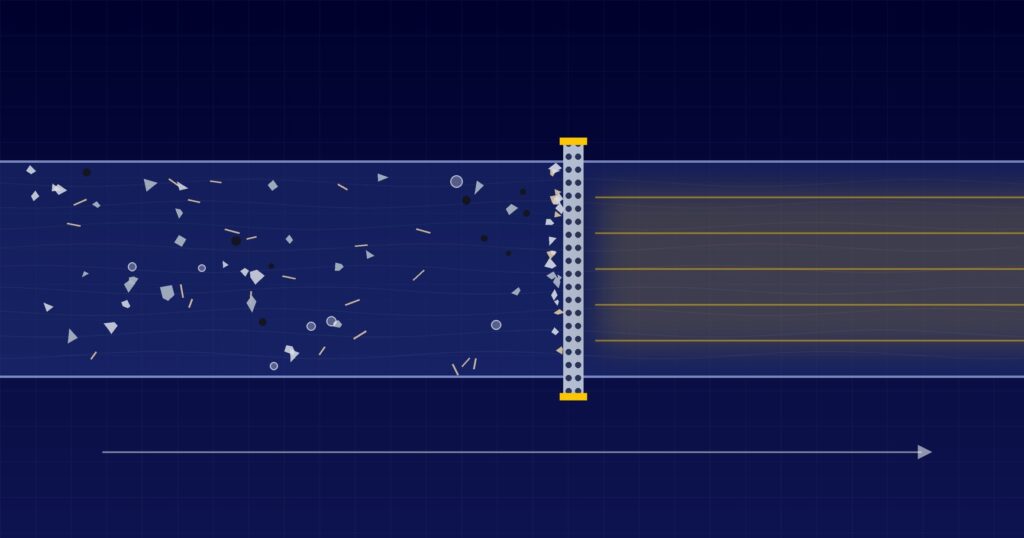
Melt filtration removes solid particles. Polymers that melt together, volatiles and odours are handled by sorting, washing and degassing, not by the screen changer.
Why mixed post-consumer and post-industrial streams are harder to filter
Post-industrial scrap – edge trim, start-up waste, off-spec rolls and production rejects from converters – usually contains one polymer or a few known polymers, with a documented processing history and relatively uniform contamination. Post-consumer waste is different: packaging, film and rigid containers collected after use arrive with labels, paper, adhesives, food residues, metal, soil and other polymers, and the mix changes from bale to bale.
When a recycling line runs both streams together, the filtration system has to be sized for the dirtiest batch, not for the average of the blend. A filter that copes comfortably with the post-industrial share can be overwhelmed every time a heavily contaminated post-consumer bale reaches the extruder. The result is rising melt pressure, unplanned screen changes and swings in pellet quality.
Demand for good recyclate is also rising: Article 7 of Regulation (EU) 2025/40 (PPWR) sets minimum recycled content for plastic packaging, applying from 1 January 2030, or three years after the implementing act on the calculation method if that comes later. Pellets from mixed waste have to meet the quality those applications require.
Before comparing filtration systems, answer three questions about your feedstock:
- How much contamination by weight do your dirtiest batches carry, not your average ones?
- What type of contamination is it: hard and abrasive, soft and deformable, or polymers that melt along with the main resin?
- What pellet quality does your customer require: general-purpose recyclate, or film-grade and other demanding applications?
What is in mixed plastic waste: a contaminant-by-contaminant guide
Melt filtration removes particles that stay solid or semi-solid at processing temperature. How each contaminant behaves in the melt decides whether a screen changer can remove it and what the filtration system has to withstand.
| Contaminant | Typical source in mixed waste | Behaviour in the melt | Removed by melt filtration? |
|---|---|---|---|
| Paper, cardboard and label residues | Labels, cartons, paper-backed packaging | Soft particles that absorb melt, char in hot zones and cause black specks | Yes, but large volumes load screens quickly |
| Aluminium foil and metal fragments | Laminated packaging, caps, closures | Hard, non-deformable and abrasive | Yes; the filtration system has to withstand hard particles |
| Glass, sand, stone, soil | Bottles, agricultural film, construction waste | Hard and abrasive | Yes; same abrasive load as metal |
| Wood and other organics | Pallet, agricultural and construction waste | Chars at processing temperature and can release gas and odour | The particles yes; gas and odour no |
| Gels and cross-linked polymer | Degraded resin, cross-linked PE | Deformable; can squeeze through a screen under high pressure | Partially; finer filtration helps |
| Higher-melting polymers that stay solid (e.g. PET or PA in a polyolefin stream) | Multilayer packaging, mixed rigid streams | Behave as solid particles at polyolefin processing temperature | Yes, as solid particles |
| Polymers that melt with the main resin (e.g. PP in PE) | Mixed polyolefin streams | Become part of the melt | No; this is a sorting issue, not a filtration issue |
What melt filtration cannot fix
A screen changer removes solid and semi-solid particles. It does not separate incompatible polymers that are already molten, it does not remove volatiles, moisture or odours, and it cannot reverse thermal degradation that has already happened in the extruder. Those problems belong upstream or elsewhere in the line: sorting, washing and drying before extrusion, and vacuum degassing during extrusion. When the dirtiest batches carry more contamination than any filtration system is rated for, improve sorting and washing first. Being clear about this boundary avoids buying a filter to solve a problem that filtration cannot solve.
Why conventional screen changers struggle on mixed feedstock
A manual or hydraulic screen changer has one way to deal with a loaded screen: interrupt the flow and change it. Every change means minutes of downtime at every screen change, a pressure event when the line restarts and, often, restart scrap. On a mixed stream the problem grows when a dirty batch arrives: screens load faster, changes become more frequent and the output of the line ends up limited by the screen changer rather than by the extruder.
Screen changers that keep the line running remove that limit, but only if they are sized for the contamination of the dirtiest batch. For the difference between the two approaches, see the continuous vs discontinuous screen changer comparison.
Cofit systems for contaminated recycled melts
For recycled PET, Cofit’s solution is ScrapeAway, an automatic, continuous and self-cleaning laser melt filter. For other contaminated recycled melts, Cofit offers GorillaBelt and ScrapeAway. GorillaBelt is an automatic melt filtration system that handles contamination up to 10% by weight.
GorillaBelt: automatic melt filtration system
GorillaBelt is an automatic melt filtration system for recycling applications with high contamination, both post-consumer and post-industrial. GorillaBelt handles contamination up to 10% by weight, including metal fragments, aluminium foil, paper, cross-linked polymer and more.
The filter belt advances automatically to fresh filtration area when ΔP reaches the set threshold: GorillaBelt does not clean the loaded belt, it renews it, and the line keeps running. Maximum operating pressure is 210 bar, operating temperature is up to 350 °C and throughput ranges from 500 to 2,000 kg/h. On recycling lines running more than 3 screen changes per shift, GorillaBelt reduces downtime by up to 90% compared with manual screen changers.
ScrapeAway: automatic, continuous and self-cleaning laser melt filter
ScrapeAway is an automatic, continuous and self-cleaning laser melt filter for high contamination levels. The melt flows through two laser-drilled filter discs from the outside in; as the discs rotate, fixed scrapers remove the contaminants at constant pressure and an automatic discharge system carries them out. It is a closed system, with no contact between the melt and the air.
ScrapeAway filters from 100 to 1,000 µm, depending on the flow behaviour of the material, with a maximum pressure of 250 bar, a maximum temperature of 300 °C and melt loss below 1%. Throughput reaches up to 5,000 kg/h per unit (indicative values referred to 1,000 Pa·s and 5.5 kg/h·cm²); for higher throughput or finer filtration, 2 ScrapeAway units can be combined in parallel. The filter discs stay in service for weeks or months. Applications include recycling and repelletizing of PP, PE, PET, PS and ABS, direct extrusion of pipe from recycled material and PP/PET strapping; ScrapeAway is also effective on elastomers.
Not sure which system fits your process? Request a Technical Alignment.
Which system for which mixed stream
Mixed post-consumer and post-industrial film waste
Post-consumer film, such as packaging and agricultural film, brings soil, paper and label residues into a blend with post-industrial film scrap, with large swings from bale to bale. Size the filtration for the dirtiest bale, not for the post-industrial share. For this kind of contaminated recycled melt, Cofit offers GorillaBelt and ScrapeAway: request a technical alignment with your feedstock data to define the right system.
Rigid post-consumer packaging with labels and caps
Labels, adhesives and metal from closures add solid contamination to rigid packaging streams. Keep in mind that PP mixed into a PE stream melts and passes through any screen: that is a sorting question, not a filtration one. For the solid contamination, Cofit offers GorillaBelt and ScrapeAway, with the choice made on your real feedstock data.
Packaging with aluminium laminates and metal parts
Aluminium fragments are hard and abrasive, and higher-melting layers such as PET or PA behave as solid particles in a polyolefin melt. GorillaBelt handles metal fragments, aluminium foil, paper, cross-linked polymer and more, and renews the filter belt automatically as it loads. Request a technical alignment to size it on your feedstock.
Recycled PET
For recycled PET, Cofit’s solution is ScrapeAway, which filters from 100 to 1,000 µm. If your application requires finer filtration, request a technical alignment. For the specific requirements of PET, see the PET recycling filtration guide.
Clean in-house regrind is not a recycling-line problem
Not every blend of virgin and reprocessed material is a recycling case. Clean regrind returned to the production line it came from is a clean or semi-clean application: there, the AP Series, a continuous and self-cleaning double cartridge screen changer, works with virgin material and clean regrind, also with low recycled content. The AP Series is not designed for recycling lines: for contaminated recycled melts, see GorillaBelt and ScrapeAway. Background on blending: mixing virgin and recycled raw materials for plastic film.
What do screen changes cost your line?
Estimate the output your line loses to screen changes with the calculator.
Calculate Your Lost ProductionFor a complete overview of screen changer types and selection criteria, see Screen Changers for Plastic Extrusion: The Complete Guide.
Frequently asked questions
Sources and further reading
- Rauwendaal, C. – Polymer Extrusion, Hanser
- Tadmor, Z. and Gogos, C. G. – Principles of Polymer Processing, Wiley
- European Union – Regulation (EU) 2025/40 on packaging and packaging waste (PPWR), Article 7
- Association of Plastic Recyclers – APR Design® Guide for Plastics Recyclability
Not sure which system fits your mixed stream?
Send us your feedstock data – polymers, contamination level and type, throughput – and the Cofit team will help you define whether GorillaBelt or ScrapeAway fits your line.
Request a Technical Alignment Calculate Your Lost Production
Cofit designs screen changers that keep the line running, for clean and semi-clean applications and for post-consumer and post-industrial recycling, and supports them directly.
Request a technical alignment to upgrade your extrusion line or ask us about any product or service.