

Extrusion Coating Filtration: How to Choose a Screen Changer for High-Speed Coating Lines
Direct answer
For extrusion coating of paper, board, aluminium foil and film, choose a screen changer that keeps the line running and filters fine enough to stop gels, black specks and foreign particles before the die.
Cofit’s AP Series is a continuous and self-cleaning double cartridge screen changer. The operator uses a key to actuate the flow valves: the resulting backflush of melt cleans the screen without stopping the line. With the AP Series, the line keeps running with stable melt pressure while the screen is cleaned: one cartridge keeps filtering while the other is backflushed, with minimal pressure disturbance during cleaning.
It filters down to 3 µm, allows metal nonwoven screens and needs no hydraulic control unit.
Why Melt Filtration Is Critical in Extrusion Coating
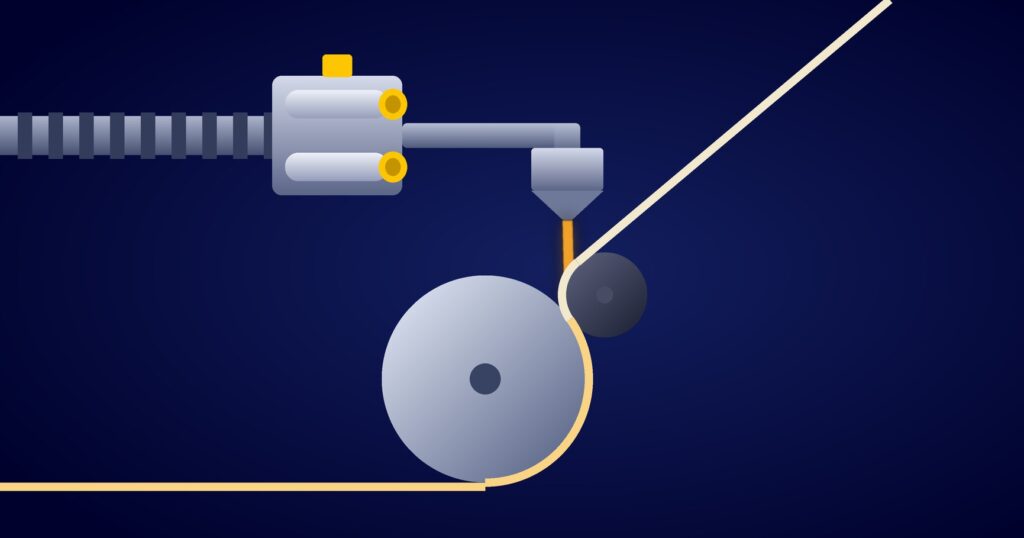
In extrusion coating, a molten polymer curtain leaves a flat die and is pressed onto a moving substrate (paper, paperboard, aluminium foil or plastic film) in the nip between a pressure roll and a chill roll. The coating is thin and the line runs fast, so whatever the melt carries is spread across a wide web in a fraction of a second.
A particle that would be a cosmetic speck in a thick sheet can become a functional defect in a coating: a pinhole that opens a moisture or grease barrier, a gel that shows as a bump after printing or lamination, or a die line that runs the full length of a reel. The screen changer is the last point where those particles can be removed before they reach the die.
What a Screen Change Costs on a Coating Line
With a manual or discontinuous screen changer, every screen change stops or interrupts the melt flow. On a coating line, the curtain stops too: after the restart, coat weight and adhesion have to come back into specification, and the coated material produced in between is scrap, substrate included. Repeated across shifts, these stops reduce sellable output.
How much production is your line losing to screen changes? Calculate Your Lost Production with the free calculator: enter your throughput, stop frequency and shift schedule.
Coating Defects Linked to the Melt, and Which Ones Filtration Can Fix
Melt filtration removes what the melt carries to the screen. It does not fix defects that come from the process, the substrate or degradation that forms after the screen.
| Defect | Typical melt-related cause | What melt filtration can do |
|---|---|---|
| Gels (fish eyes) | Crosslinked or oxidised polymer, high-molecular-weight particles, undispersed additives | Fine filtration with enough area retains hard gels; deformable gels can pass. Source control still matters |
| Black specks | Degraded or carbonised polymer released from the extruder or the adapter | Retains specks generated upstream of the screen, not degradation formed downstream of it |
| Foreign particles | Dust, fibres or metal fines entering with the feedstock | Retains particles larger than the screen rating |
| Pinholes | Particles and gels that break a thin coating | Removes the melt-borne share; substrate and coat weight also play a role |
| Die lines | Particles or degraded material caught at the die lips | Cleaner melt reduces how often the die lips catch material; die maintenance stays necessary |
| Coat weight variation at screen changes | Stop-and-restart pressure event of a manual screen changer | A screen changer that keeps the line running avoids this event |
| Poor adhesion, neck-in, edge bead | Process conditions such as melt temperature, air gap, line speed and substrate treatment | Not a filtration problem |
For gels, fine filtration helps but is not the whole answer. Metal nonwoven screens present a tortuous flow path and can retain more deformable gels than woven mesh, but they need a large filtration area to avoid excessive back pressure. For gel types and how to diagnose their source, see Gel Defects in Film Extrusion.
Stable Melt Pressure in Extrusion Coating: What the Screen Changer Controls
Coating lines need stable melt pressure: output variations at the die show up as coat weight variations along the web. Feeding, screw and temperature conditions, die settings and line speed all affect it. The screen changer is one source of pressure disturbance you can remove.
With a manual screen changer, every change is a stop-and-restart pressure event: pressure drops when the screen pack comes out and has to be brought back after the restart. Between changes, upstream pressure also rises as the screen loads.
With the AP Series, the line keeps running with stable melt pressure while the screen is cleaned: one cartridge keeps filtering while the other is backflushed, with minimal pressure disturbance during cleaning. Cleaning restores the filtration area during operation instead of running the screen to saturation, greatly reducing ΔP variation.
What the screen changer does not control is the coat weight profile across the web, which depends on die adjustment and process conditions.
What to Look For in a Screen Changer for Extrusion Coating
- No line stop for screen changes. Every stop on a coating line wastes substrate as well as polymer.
- Fine filtration with enough area. Fine screens on a small filtration area raise back pressure quickly; a large area allows finer media, including metal nonwoven screens.
- Temperature and pressure ratings. Check the maximum operating temperature and pressure of the screen changer against your process conditions.
- Polymer compatibility. Coating lines run polyolefins such as LDPE and PP, and in coextrusion PET, nylon (PA) or EVOH layers: check that the screen changer is suited to every resin on the line.
- Footprint near the die. A unit with no hydraulic control unit is easier to fit on an existing line.
- Edge trim. If polymer trim is fed back into the extruder, the screen changer must handle clean regrind.
Automatic, Continuous or Self-Cleaning: What the Terms Mean
Buyers often ask for an automatic screen changer for a coating line. What they usually need is a screen changer that does not stop the line at every screen change. The terms describe different things:
- Discontinuous (manual or hydraulic): the line stops or the melt flow is interrupted at every screen change.
- Automatic: the screen changer renews or cleans the filtration area without operator action, for example a filter belt that advances when ΔP reaches a set threshold.
- Continuous and self-cleaning: melt keeps flowing while the screen is cleaned in place. The Cofit AP Series belongs here: the operator activates cleaning with a key, and the line keeps running.
For a coating line, the deciding question is not whether cleaning starts by itself. It is whether the line keeps running, and how much melt pressure moves while the screen is cleaned. For a full comparison, see Continuous vs Discontinuous Screen Changer.
Cofit AP Series on Extrusion Coating Lines
Cofit designs screen changers that keep the line running, with more than 50 years of history, more than 800 installations and 15+ global OEMs. For extrusion coating, Cofit’s solution is the AP Series, designed for clean and semi-clean applications: virgin material and clean regrind, also with low recycled content.
| Parameter | AP Series |
|---|---|
| Type | Continuous and self-cleaning double cartridge screen changer, two cartridges in parallel |
| Cleaning | Activated by the operator with a key; backflush of melt, no line stop |
| Filtration fineness | Down to 3 µm; metal nonwoven screens allowed |
| Maximum operating temperature | Up to 350 °C |
| Maximum operating pressure | Over 500 bar |
| Throughput | 5–2,000 kg/h |
| Hydraulic control unit | Not required |
Reference: Amcor Flexibles Italia. Amcor Flexibles Italia uses a Cofit AP08, a continuous and self-cleaning double cartridge screen changer, on an extrusion coating line at its plant in Lugo di Vicenza, Italy.
On lines running more than 3 screen changes per shift, the AP Series reduces downtime by up to 90% compared with manual screen changers. To check the fit with your resin, line output and die, request a Technical Alignment.
Edge Trim and Recycled Content on Coating Lines
Coating lines trim the edges of the web, where neck-in and edge bead make the coating uneven. When polymer-only trim is ground and fed back into the extruder, it enters the melt as clean regrind, within the field of application of the AP Series.
Trim that carries substrate, such as paper or foil, is a different stream: it brings solid contamination into the melt. The AP Series is not designed for recycling lines. If you plan to reprocess coated trim or to coat with post-consumer recyclate, request a Technical Alignment to define the right filtration.
Frequently Asked Questions
Sources
- Smith, R. D. (ed.) – Ultimate Web and Roll Troubleshooting Guide, TAPPI Press, Atlanta, 2013, chapter “Extrusion Coating and Lamination Defects”
- Lightfoot, E. J. – Troubleshooting Defects in Extrusion Coating, PFFC (Paper, Film & Foil Converter)
- Rauwendaal, C. – Polymer Extrusion, Hanser
- Tadmor, Z. and Gogos, C. G. – Principles of Polymer Processing, Wiley
Find Out What Screen Changes Cost Your Coating Line
Every screen change that stops your coating line costs polymer, substrate and production time. The calculator quantifies it from your own data: throughput, stop frequency and shift schedule.
Calculate Your Lost Production Request a Technical Alignment
Cofit designs screen changers that keep the line running, for clean and semi-clean applications and for post-consumer and post-industrial recycling, and supports them directly.
Request a technical alignment to upgrade your extrusion line or ask us about any product or service.