

Gel Defects in Film Extrusion: Causes, Diagnosis and What Melt Filtration Can Fix
Direct answer
A gel is a small, localized defect in the film, made of material that differs from the surrounding polymer: oxidized or crosslinked polymer, unmelted or undispersed resin, additive agglomerates or foreign matter. Because gels have several origins, there is no single cure.
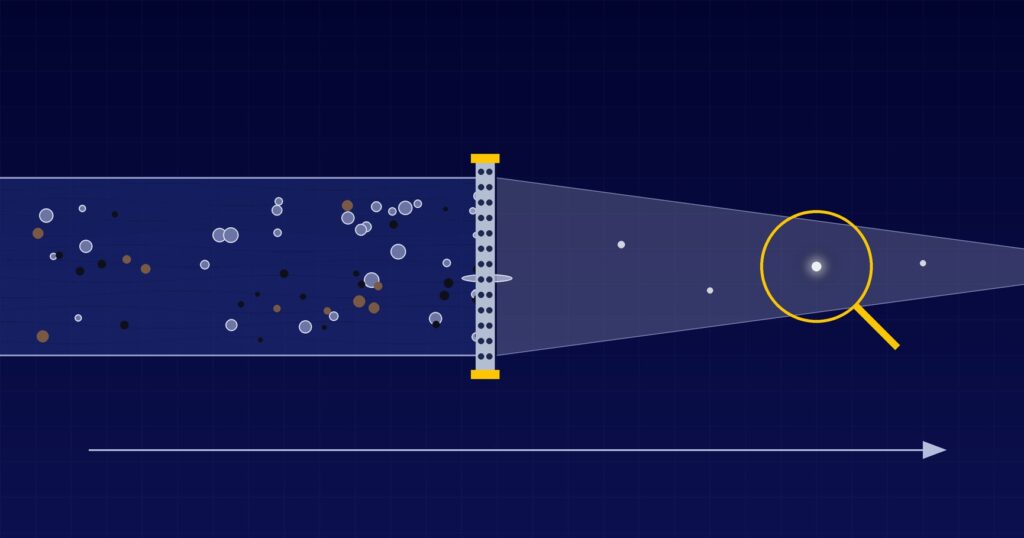
Melt filtration retains solid particles larger than the screen openings before they reach the die, and it is one of the main controls. It cannot hold back gels that form downstream of the screen, and soft gels can deform and pass through it. Start by identifying the gel type, then remove the source and size the filtration for the film you make.
What a gel is, and what it is not
In the film industry, “gel” is a catch-all term for any inclusion that produces a visible defect in the film. Many gels are small and round or elliptical; others are elongated. Their composition varies from inorganic particles and processing additives to oxidized, charred or crosslinked polymer.
The most common gel types are:
- highly oxidized polymer, which appears as brittle black specks;
- polymer crosslinked by oxidation, often discolored;
- undispersed gels: highly entangled, high molecular weight polymer that is not crosslinked but has not been mixed into the melt;
- unmelted resin or solid polymer fragments;
- filler agglomerates from masterbatches;
- foreign resin or contaminants such as metal, wood, fibers or dirt.
In polyethylene film, polymeric gels are often grouped as density gels (different crystallinity), melt-index gels (different molecular weight) and crosslinked gels.
Two distinctions help in practice. Black specks are one type of gel: oxidized or charred material, recognizable by its dark color. And contamination is a source, while a gel is a defect: dust, metal fragments or foreign polymers in the raw material can all end up as gels in the film.
| Gel type | How it typically looks | Typical origin | What melt filtration can do |
|---|---|---|---|
| Oxidized or charred polymer (black specks) | Dark, hard | Degraded resin, often from stagnant zones | Retains particles larger than the screen openings |
| Crosslinked polymer | Discolored or clear, can be soft | Oxidation and crosslinking during processing | Retains hard particles; soft ones can deform and pass |
| Undispersed (unmixed) gels | Clear, no color | High molecular weight fractions not mixed into the melt | Limited: screens can break some up; mixing in the screw is the main remedy |
| Unmelted resin | Solid fragment | Insufficient melting | Retains fragments larger than the openings |
| Additive or filler agglomerates | Variable | Poorly dispersed masterbatch | Retains agglomerates larger than the openings |
| Foreign matter | Variable | Contaminated raw material or regrind, previous runs | Retains particles larger than the openings |
Where gels come from
Gels can form at almost every stage between the resin and the die:
- Degraded resin in the extruder. Polymer that stays too long in stagnant regions of the screw degrades and slowly releases black specks and brown soft gels. This typically produces a low, continuous level of gels.
- High molecular weight fractions that are not homogenized, a known issue with bimodal and multimodal resins.
- Unmelted resin that leaves the melting section as solid fragments.
- Catalyst or additive residues and poorly dispersed masterbatch.
- Contaminated raw material or regrind, including foreign polymers that do not mix with the main resin.
- Residual material from previous production runs left in the extruder, adapter or die.
How to diagnose the source
Troubleshooting is difficult because so many gel types exist: the first step is always to identify the gel, then trace it back to its likely source.
- Look at the gel. Dark color points to oxidized or charred material. A clear gel without color is more likely undispersed or unmelted polymer. A visible core suggests a foreign particle or an agglomerate.
- Analyze it. Under a hot-stage microscope, an undispersed gel melts as the temperature rises and recrystallizes when it falls; an oxidized or crosslinked gel does not behave this way. Compositional analysis identifies foreign polymers and inorganic particles.
- Count it over time. Optical gel counting systems measure gels in the film, so you can see whether the level is constant or comes in bursts.
- Read the pattern. A low, continuous level of oxidized gels typically points to degradation inside the screw. Gels that appear after a start-up, a material change or a new resin lot point to residues or to the raw material.
- Inspect the used screen pack. What the screens retained shows what is reaching the filter, and how much of it.
- Locate degradation in the screw. If the analysis points to degraded resin, the screw can be pulled out hot, a few diameters at a time, to find where dark, degraded material collects.
What melt filtration can and cannot fix
Melt filtration is designed to remove contaminants before the melt reaches the die, and it protects the die and the film from particles that would otherwise pass through.
What it can do:
- retain non-deformable particles larger than the screen openings: highly degraded, charred or heavily crosslinked polymer, mineral particles, unmelted fragments and foreign matter;
- break up and disperse part of the gels as the melt passes through the screens.
What it cannot do:
- stop deformable gels reliably: depending on their crosslinking and chain structure, they can change shape, squeeze through openings smaller than their size and re-form downstream of the screen;
- reach gels that form after the filter, for example from material degrading in the adapter or the die;
- remove the source: degraded material keeps coming from a stagnant zone in the screw, and undispersed gels need enough mixing stress in the extruder, until the process itself is corrected.
There is also a trade-off. Finer screens retain smaller particles, but they load faster: differential pressure rises sooner and screen changes become more frequent. In film lines with conventional manual or hydraulic screen changers, every change means stopping the line or accepting a stop-and-restart pressure event, with lost production and restart scrap.
Gel-sensitive applications
Gels are most critical where appearance and surface quality define the product:
- blown film;
- cast film;
- stretch film;
- BOPP film, on the co-extruders that produce a skin or intermediate layer;
- extrusion coating, where gels show up as coating defects;
- optical film.
In high-quality packaging film, even very small gels can make the product unacceptable.
Choosing melt filtration for gel-sensitive film
Four factors decide whether filtration helps or simply moves the problem:
- Filtration fineness. Finer filtration retains smaller particles but increases differential pressure and screen loading. The right level depends on the resin, the gel type and the quality target; the mesh-micron converter gives the nominal correspondence between mesh and micron.
- Filter area. A larger filtering surface keeps differential pressure lower at the same fineness, which makes fine filtration sustainable in production.
- Filter media. Where gels must be retained, depth media are typically used rather than thin woven screens. Metal nonwoven screens are one option.
- Screen changer type. A screen changer that keeps the line running avoids the line stops and restart scrap of conventional screen changes.
For clean and semi-clean film applications, Cofit’s solution is the AP Series, a continuous and self-cleaning double cartridge screen changer. While one cartridge filters, the operator uses a key to actuate the flow valves on the other: the resulting backflush of melt cleans the screen without stopping the line. Its large filtering surface allows metal nonwoven screens, with filtration down to 3 µm and minimal pressure disturbance during cleaning. AP has no hydraulic control unit, works up to 350 °C and covers 5–2,000 kg/h. On lines running more than 3 screen changes per shift, AP reduces downtime by up to 90% compared with manual screen changers. AP Series is designed for virgin material, clean regrind and low recycled content; it is not designed for recycling lines.
For film made from recycled material, the filtration problem is different. For recycled PET, Cofit’s solution is ScrapeAway, an automatic, continuous and self-cleaning laser melt filter. For other contaminated recycled melts, Cofit offers GorillaBelt and ScrapeAway. GorillaBelt is an automatic melt filtration system that handles contamination up to 10% by weight. Not sure which system fits your process? Request a Technical Alignment.
Process measures beyond filtration
Filtration works best together with a process that generates fewer gels in the first place:
- proper temperature control along the extruder;
- screw design without stagnant zones, with enough mixing stress to disperse high molecular weight fractions;
- high-quality raw materials and controlled regrind;
- good process maintenance, including cleaning between production runs.
What do screen changes cost your line?
Estimate the output your line loses to screen changes with the calculator.
Calculate Your Lost ProductionRelated content: Blown Film Extrusion Filtration: The Complete Engineering Guide · Screen Changers for Plastic Extrusion: The Complete Guide · Polymer Melt Filtration: The Complete Guide · Screen Changer for BOPP Film Extrusion
Frequently asked questions
Sources and further reading
- Spalding, M. A. et al. – Reducing Low-Level Background Gels in PE Film, Plastics Technology
- The analysis of “Gels” in polymer films, Microscopy and Microanalysis, Cambridge University Press, DOI 10.1017/S0424820100153786
- US Patent 4,661,249 – Prefilter device for polymeric material (deformable and non-deformable gels)
- US Patent 5,462,653 – Apparatus for continuous polymer filtration (gel filtration and depth media)
- Rauwendaal, C. – Polymer Extrusion, Hanser
- Tadmor, Z. and Gogos, C. G. – Principles of Polymer Processing, Wiley
Gels in your film?
Tell us your resin, application, throughput and the type of gels you see, and the Cofit team will help you define the filtration your line needs.
Request a Technical Alignment Calculate Your Lost Production
Cofit designs screen changers that keep the line running, for clean and semi-clean applications and for post-consumer and post-industrial recycling, and supports them directly.
Request a technical alignment to upgrade your extrusion line or ask us about any product or service.