

Screen Changers for Plastic Extrusion: The Complete Guide (2026)
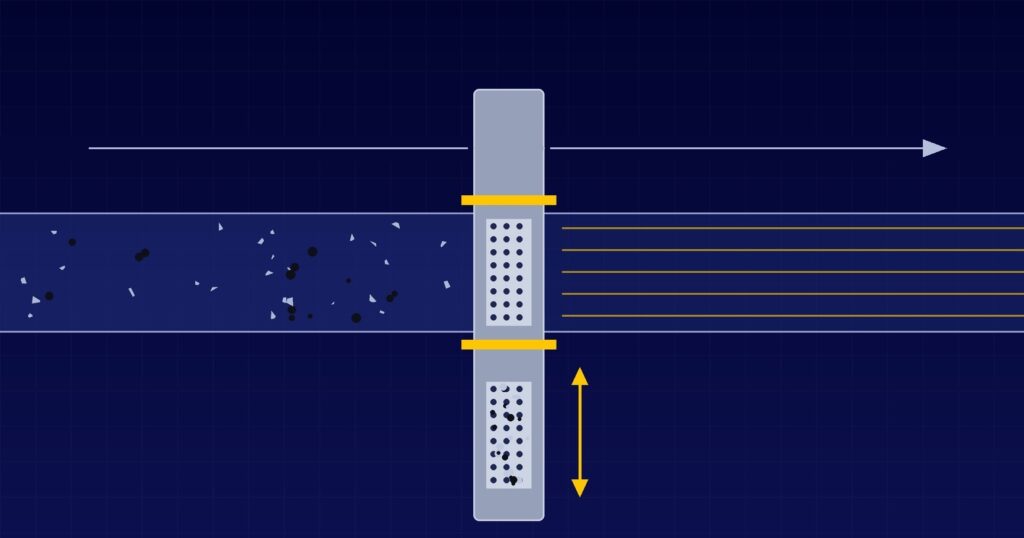
A screen changer is a filtration device installed between the extruder and the die, designed to intercept contamination before it reaches downstream equipment. The type you choose directly determines how often your line stops, how stable your melt pressure is, and how much production you lose every year.
Every manual screen change stops the line for the swap itself, plus the time melt pressure and product quality need to stabilise. Repeated several times per shift, those stops add up to a significant share of the year’s production. Screen changers that keep the line running avoid those stops.
This guide explains every screen changer type used in plastic extrusion, how each works technically, what it costs to run the wrong one, and how to select the right technology for your specific application.
1. What Does a Screen Changer Actually Do?
Every polymer melt stream contains contaminants — crosslinked particles, degraded polymer, metal fragments, paper residues from recycled material, and microscopic gel-forming agglomerates. Left unfiltered, these particles cause visible defects in film (fish eyes, streaks), filament breaks in fiber spinning, die build-up, and premature wear on precision dies.
The screen changer holds a filtration screen pack — a stack of woven metal meshes supported by a breaker plate — directly in the melt flow path. As polymer passes through, particles larger than the mesh opening are captured. Over time, the screen loads with contamination, differential pressure (ΔP) across the filter rises, and the screen must be replaced.
How that replacement happens — with a full line stop or without one — is the fundamental engineering and commercial difference between screen changer technologies.
2. Types of Screen Changers: Technical Overview
2.1 Manual and Hydraulic Slide Plate Screen Changers
The simplest design. A breaker plate carrying the screen pack sits in a slide plate that can be pulled out of the melt channel — either manually by an operator or hydraulically. The extrusion line must stop, or at minimum experience a significant pressure drop, during the swap.
Every change means a line stop. Scrap is generated both during the stop and during pressure restabilization after restart. In applications with clean virgin material changed infrequently, this approach is economically acceptable. In anything else, it is a major source of preventable production losses.
2.2 Single and Dual Piston Screen Changers
A hydraulic piston shifts a new screen pack into the melt channel, displacing the spent one. In single-piston designs the process still requires a brief stop. Dual-piston systems operate two cavities alternately: while one filters, the other is being prepped with a fresh screen. Switching between them takes seconds rather than minutes.
This architecture substantially reduces downtime but does not fully eliminate melt pressure fluctuation at the moment of cavity switching. Pressure excursions are common during the transition — acceptable in many applications, problematic in quality-sensitive ones such as optical film or fine fiber spinning.
2.3 Continuous and Self-Cleaning Double Cartridge Screen Changers
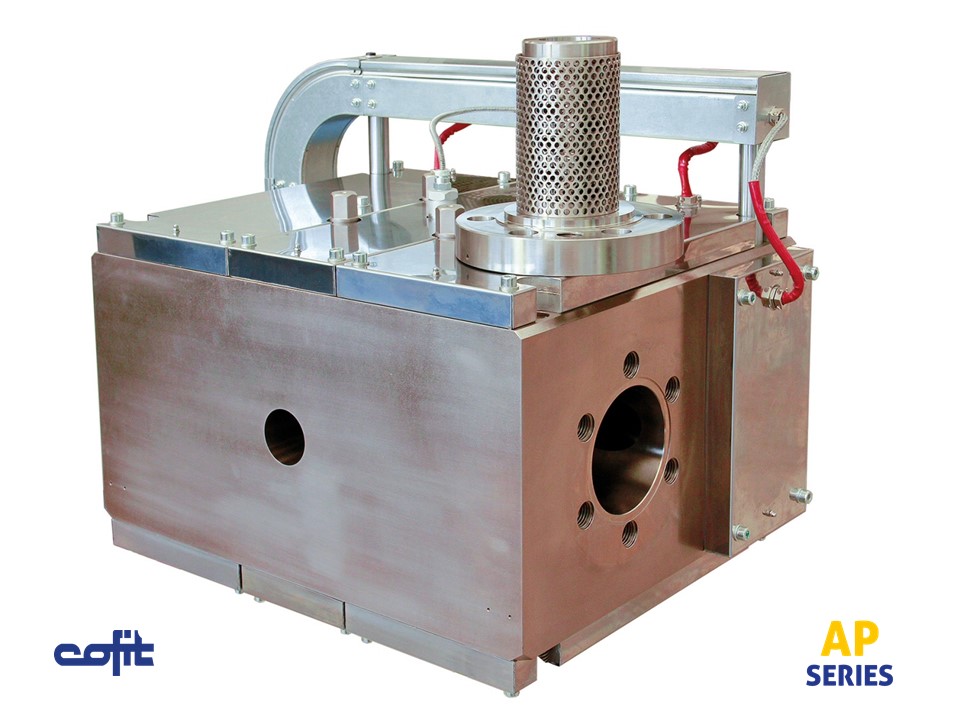
Two filter cartridges work in parallel: while one filters, the other is cleaned. The operator uses a key to actuate the flow valves: the resulting backflush of melt cleans the screen without stopping the line, with minimal pressure disturbance during cleaning.
Cofit’s AP Series, a continuous and self-cleaning double cartridge screen changer, filters down to 3 µm and allows metal nonwoven screens. It operates at over 500 bar and up to 350°C, handles 5–2,000 kg/h and needs no hydraulic control unit. It is designed for clean and semi-clean applications: virgin material and clean regrind, also with low recycled content. On lines running more than 3 screen changes per shift, it reduces downtime by up to 90% compared with manual screen changers.
2.4 Automatic Belt Screen Changers
A filtration belt advances automatically through the melt channel as contamination accumulates. When ΔP reaches a preset threshold, the belt advances to expose clean filtration area, without interrupting production. The large filtration surface of belt designs absorbs high contamination loads. Cofit’s GorillaBelt, an automatic melt filtration system, is designed for high-contamination recycling, both post-consumer and post-industrial.
2.5 Laser Disc and Scraper Systems
A filter disc presents clean filtration surface to the melt while scrapers remove contaminants from the loaded surface and discharge them, without stopping the line. These designs are widely used for contaminated recycled melts, including PET.
Cofit’s ScrapeAway is an automatic, continuous and self-cleaning laser melt filter: laser-drilled discs with fixed scrapers, filtration from 100 to 1,000 µm, effective also on elastomers, with melt loss below 1%.
3. Screen Changer Comparison Table
Table 1 — Screen changer types compared
|
Screen Changer Type |
Downtime per Change |
Melt Pressure During Change |
Typical Applications |
|
Manual slide plate |
Full line stop |
Poor — pressure spikes at every change |
Low-volume lines, infrequent changes |
|
Hydraulic slide / single piston |
Seconds to minutes (brief stop) |
Moderate — short interruption |
Medium lines, occasional changes |
|
Dual piston |
Seconds (cavity switch) |
Fair — excursion at switchover |
Virgin polymer, occasional changes |
|
Continuous and self-cleaning double cartridge (AP Series) |
No line stop |
Minimal pressure disturbance during cleaning |
Film, fiber, coating, sheet, pipe, cable; virgin, clean regrind, low recycled content |
|
Automatic belt (GorillaBelt) |
No line stop |
No stop-and-restart pressure event |
High-contamination recycling |
|
Laser melt filter (ScrapeAway) |
No line stop |
No stop-and-restart pressure event |
Contaminated recycled melts (PP, PE, PET, PS, ABS) |
4. The Productivity Cost of Manual Screen Changes
The cost of manual screen changes is easy to quantify with four numbers from your shift log: screen changes per shift, minutes per stop until the product is back in specification, throughput and the value of each kilogram produced. Multiply stops per shift by minutes per stop, shifts per day and operating days per year, divide by 60 and multiply by throughput: that is the production your line loses every year to screen changes alone, before restart scrap, pressure instability and operator time.
📊 How much production is your line losing to screen changes? Calculate Your Lost Production with the free calculator: enter your throughput, stop frequency and shift schedule and see your monthly lost production in under two minutes.
5. Melt Pressure Stability: Why It Matters as Much as Downtime
Downtime is visible and easy to measure. Melt pressure instability is less obvious — but its quality consequences are equally significant.
Every manual screen change creates a pressure event: pressure drops sharply as the screen pack is removed, then spikes as the new one is loaded. In film extrusion, this translates directly into gauge variation (thickness bands), surface defects, and off-spec material that must be downgraded or scrapped. In fiber spinning, pressure excursions cause filament breaks and tenacity variation across a bobbin.
Screen changers that keep the line running avoid the stop and restart behind this pressure event: the AP Series, for example, has minimal pressure disturbance during cleaning, greatly reducing ΔP variation. This improves dimensional consistency and reduces scrap linked to pressure events.
For film and fiber producers, eliminating manual screen changes removes a recurring source of pressure-driven defects, independently of filtration fineness.
6. Gel Defects and Filtration Fineness
Gels — sometimes called fish eyes — are localized regions of higher molecular weight, crosslinked polymer, or undispersed additive that appear as visible inclusions in transparent or thin film. They are a costly defect in film production because they cannot be reworked and can lead to customer rejections.
Standard screen packs with coarse mesh capture hard contaminants but allow gel particles to pass. Gel reduction requires both fine filtration fineness and sufficient filtering area: fine enough to intercept gel agglomerates, large enough not to create excessive back pressure.
Continuous screen changers with large filtering surfaces — such as the Cofit AP Series, a continuous and self-cleaning double cartridge screen changer, which reaches filtration fineness down to 3 µm — enable the use of metal nonwoven screens. Nonwoven media presents a tortuous flow path that captures deformable gel particles that woven mesh intercepts less effectively. On small-area piston systems, nonwoven screens tend to generate high back pressure, which limits their use.
For film producers dealing with persistent gel counts, combining a large filtration area with nonwoven media is a technical lever worth evaluating on the screen changer side, alongside raw material and process conditions.
7. How to Select the Right Screen Changer for Your Application
Three parameters define the selection decision: contamination level of the processed material, required filtration fineness, and acceptable downtime tolerance.
Contamination Level
Virgin polymer, clean regrind and low recycled content (clean and semi-clean applications): a continuous and self-cleaning screen changer such as the AP Series filters down to 3 µm without stopping the line.
Post-consumer and post-industrial recycled material: higher and variable contamination, including hard contaminants. For recycled PET, Cofit’s solution is ScrapeAway, an automatic, continuous and self-cleaning laser melt filter. For other contaminated recycled melts, Cofit offers GorillaBelt and ScrapeAway. GorillaBelt is an automatic melt filtration system that handles contamination up to 10% by weight. Not sure which system fits your process? Request a Technical Alignment.
Filtration Fineness Requirements
Blown film, cast film and pipe: typically 100–200 mesh (74–149 µm).
Fiber spinning, BOPP and extrusion coating: 250–500 mesh (25–61 µm), where a continuous and self-cleaning screen changer is strongly recommended.
Mesh-to-micron values per ASTM E11, as engineering guidance: always confirm the micron rating of your screen packs with your supplier.
For reference values by application, see the mesh to micron conversion chart.
Application Selection Guide
Table 2 — Recommended screen changer technology by application
|
Application |
Material |
Recommended Technology |
Key Priority |
|
Blown / cast film (virgin PE, PP) |
Clean |
Continuous and self-cleaning double cartridge (AP Series) |
Gel reduction, minimal pressure disturbance |
|
BOPP film (co-extruders: skin or intermediate layer) |
Clean |
Continuous and self-cleaning double cartridge (AP Series) |
Fine filtration down to 3 µm |
|
Fiber / nonwoven |
Clean |
Continuous and self-cleaning double cartridge (AP Series) |
Consistent quality, no line stop |
|
Pipe / sheet |
Clean or semi-clean |
Continuous and self-cleaning double cartridge (AP Series) |
Pressure stability, throughput |
|
Wire & cable insulation (PE, PP) |
Clean |
Continuous and self-cleaning double cartridge (AP Series) |
Insulation purity, gel reduction |
|
Recycled PET |
Recycled, contaminated |
ScrapeAway |
Uptime, contamination handling |
|
Other contaminated recycled melts (post-consumer / post-industrial) |
Recycled, contaminated |
GorillaBelt or ScrapeAway — request a technical alignment |
Uptime, contamination handling |
8. Screen Changers in Plastic Recycling: A Growing Priority
Plastic recycling is a growing application for melt filtration equipment. In the EU, the Packaging and Packaging Waste Regulation (Article 7 of Regulation (EU) 2025/40, PPWR) sets minimum post-consumer recycled content for plastic packaging from 1 January 2030, or three years after the Commission’s implementing act on the calculation method enters into force, whichever is later: for example, 30% for contact-sensitive packaging made mainly of PET and for single-use plastic beverage bottles, rising to 50% and 65% respectively from 2040. These targets require more recycled polymer of consistent quality.
Recycled polymer streams challenge every element of a filtration system: contamination is higher, more variable, and harder. Paper, aluminum, adhesive residues, glass, and incompatible polymers all appear in PCR feedstock. Filtration must handle this contamination continuously — frequent stops for manual screen changes in recycling lines create downtime that compounds faster than in virgin polymer processing, precisely because screens load more quickly. When post-consumer and post-industrial waste are processed together, size the filtration for the dirtiest batch: see how to choose melt filtration for mixed plastic waste.
The operational model for recycling filtration is fundamentally different from virgin polymer processing. The question is not how to minimize screen changes — it is how to avoid stopping the line for them, while keeping pressure disturbances to a minimum.
9. Frequently Asked Questions
What is the difference between a continuous and a discontinuous screen changer?
A discontinuous screen changer interrupts or disturbs melt flow at every screen change: from a full line stop (manual slide plate) to a pressure spike lasting seconds (hydraulic and piston designs). A continuous screen changer replaces or cleans the screen without interrupting melt flow. See the full comparison in Continuous vs Discontinuous Screen Changer.
Can I retrofit a continuous screen changer to an existing extruder?
Yes. Cofit screen changers are installed on existing lines between the extruder and the die or melt pipe, with connections adapted to the existing line geometry. Installation requires a planned stop.
How do I know when to change the screen?
It depends on the design, and none of the three Cofit systems stops the line. On the AP Series, the operator monitors ΔP and, when it rises, activates cleaning with a key: the backflush of melt cleans the screen. On GorillaBelt, the belt advances automatically to fresh filtration area when ΔP reaches the set threshold. On ScrapeAway, fixed scrapers clean the laser-drilled discs continuously and contaminants are discharged automatically.
What filtration fineness do I need for blown film production?
Blown film typically uses screen packs in the 100–200 mesh range (74–149 µm). High-clarity and barrier films often require 200–250 mesh (61–74 µm). The critical parameter is not just the mesh opening but the filtration area: larger area allows finer screens without excessive back pressure. For blown film, Cofit’s AP Series, a continuous and self-cleaning double cartridge screen changer, filters down to 3 µm without stopping the line.
What is the ROI of a screen changer that keeps the line running?
Payback depends on the model and on your line conditions: throughput, screen change frequency and product value. The calculator quantifies the production you lose today; if you would like a quotation, we calculate the ROI together using your plant’s actual data.
Calculate Your Lost Production
Every screen change your line makes is a quantifiable production event. The cumulative annual loss — in kilograms and in revenue — is calculable from your own operating data.
🔢 Calculate Your Lost Production: Enter your throughput, stop frequency, and shift schedule — and see in under 2 minutes how many kilograms you are currently leaving on the table each month.
📋 Request a Technical Alignment: If your application involves gel-sensitive film, PCR recycling, or high-output continuous production, Cofit engineers can review your current filtration setup and identify the specific technology fit.
Related Content
- Mesh to Micron Conversion: The Complete Reference for Extrusion Filtration
- Cofit AP Series — Continuous and Self-Cleaning Screen Changer
- Cofit GorillaBelt — Automatic Melt Filtration for Recycling
- Cofit ScrapeAway — Laser Melt Filter for Recycling
- Continuous vs Discontinuous Screen Changer: Which One Do You Need?
- Melt Filtration for Mixed Plastic Waste: How to Choose for Post-Consumer and Post-Industrial Streams
Cofit designs screen changers that keep the line running, for clean and semi-clean applications and for post-consumer and post-industrial recycling, and supports them directly.
Request a technical alignment to upgrade your extrusion line or ask us about any product or service.